
Suppose your client sends a $2,000 payment on Friday afternoon.
Their bank says “sent.” You expect the money on Monday. Monday morning arrives in Nigeria and your balance is still unchanged. Nothing in that sequence tells you, by itself, that the payment is late.
A Friday transfer can move on Friday, wait for Monday, wait for Tuesday because Monday is a relevant banking holiday, or continue over the weekend if it uses an eligible 24/7 payment rail. The answer depends on the rail, the payer’s bank cut-off, the relevant holiday calendar, the receiving provider and whether the payment has entered a review.
If you are still deciding how clients in different markets should pay you, start with how Nigerian freelancers can receive payments from US, UK and EU clients.

How do international transfer business days work?
International transfer business days are the days on which the specific institutions and payment rail involved can process or settle the transfer. Calendar days and business days are therefore not interchangeable. A payment submitted on Friday evening may not enter its next processing stage until Monday, or Tuesday when Monday is a relevant holiday. An eligible instant-payment route can behave differently. Ask:
Which processing stage has the payment reached, and is that stage open today?
That distinction explains most of the confusion around Friday payments.
The same Friday payment can follow very different calendars
Route | What Friday can mean | What the weekend changes | What to verify |
US ACH | It may enter Friday processing if submitted within the sender/provider’s applicable window | Normal ACH settlement follows banking-day schedules rather than simply counting Saturday and Sunday as ordinary settlement days | ACH support, sender cut-off, effective date, receiving-provider posting |
US domestic wire | A correctly submitted wire may settle on a Fedwire business day | Fedwire currently treats Saturdays, Sundays and Federal Reserve holidays as non-business days | The bank’s customer cut-off, wire details, receiving support |
UK payment | Timing depends on whether the client is using Faster Payments, Bacs, CHAPS or another route | Different UK rails do not share one universal weekend/holiday schedule | Exact rail, bank/provider availability, receiving-account support |
Standard euro transfer | Business-day rules can affect when the payment starts or completes | A weekend or public holiday can push processing into the next business day | Standard vs instant SEPA route and provider support |
SEPA Instant | The scheme is designed for 24/7/365 availability | Weekends do not create the same settlement pause when the instant route is supported | Both sides must support the relevant instant-payment route |
International wire / SWIFT route | Several institutions may be involved | Different countries, banks and correspondents may observe different operating calendars | Sender bank, intermediary path, receiving bank, cut-offs and review status |
For US payments specifically, ACH and wire are separate payment routes with different operating rules. Do not estimate arrival time until you know which one your client used.
“Sent Friday” contains less information than it sounds
A bank payment has several timestamps. They may all be different:
Client submitted the instruction.
Client’s bank accepted the instruction.
The payment entered the relevant processing or settlement window.
The receiving institution received the payment.
Your provider matched and credited it to your account.
The money became usable.
A client can truthfully say “I sent it Friday” while the payment is still scheduled for Monday processing.
Their banking interface may have accepted the instruction at 7:30 p.m. on Friday. That does not prove the transfer entered Friday’s settlement cycle.
This is why a screenshot showing sent, paid or completed should not become your timing model. Ask what happened at the bank or payment-rail level.
What is a bank cut-off time?
A bank cut-off time is the deadline after which a payment instruction may be treated as arriving in the next processing period or business day.

The cut-off that matters to your client can be earlier than the underlying payment system’s final operating deadline.
That difference is easy to miss.
For example, the Fedwire Funds Service currently runs a funds-transfer business day from 9:00 p.m. Eastern Time on the preceding calendar day until 7:00 p.m. ET. Saturdays, Sundays and Federal Reserve holidays are not current Fedwire Funds business days. Your client’s bank can still impose an earlier customer-facing deadline for submitting wires.
So this reasoning is unsafe:
Fedwire is open until 7 p.m. → my client can send me a wire at 6:55 p.m.
The bank may require customer instructions much earlier. The same principle applies to other payment routes. The network schedule is one layer; the sending institution’s cut-off is another.
If payment timing matters, include the correct rail and payment terms when you invoice a US client from Nigeria rather than writing only “bank transfer.”

A Friday-to-Monday example
Consider an illustrative payment using a business-day bank-transfer route.
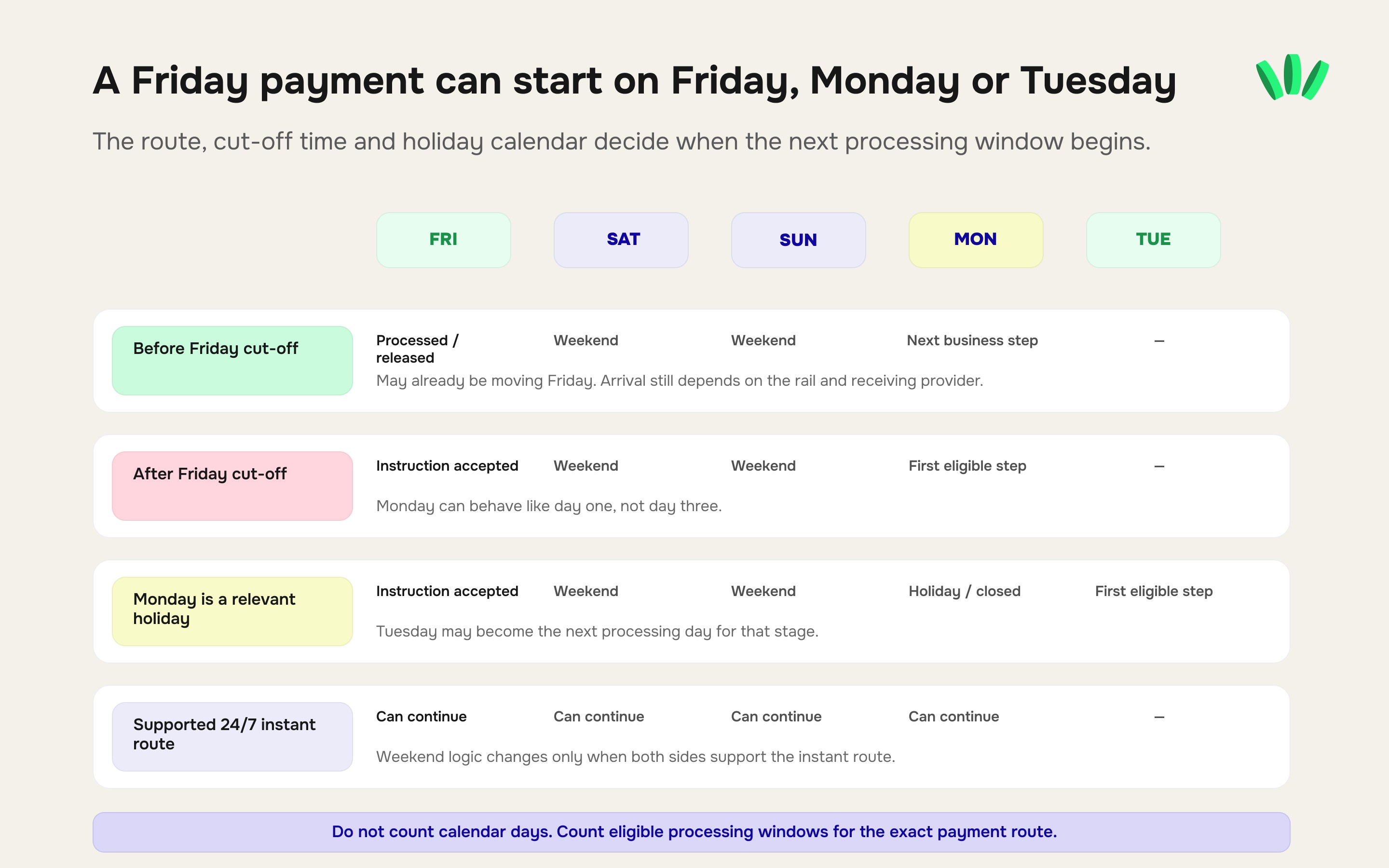
Scenario A: Friday, before the relevant cut-off
The client submits the correct payment before their bank or provider’s applicable Friday deadline. The payment may enter Friday’s processing cycle.
What happens next depends on the rail and receiving provider. It could settle or arrive Friday. It could reach the receiving institution Friday but appear in your balance later. Or the route could have a normal next-business-day settlement process.
“Before cut-off” does not mean “guaranteed Friday arrival.”
Scenario B: Friday, after the relevant cut-off
The client submits after the bank’s Friday deadline. The bank may accept the instruction but treat it as a payment for the next eligible processing day. Saturday and Sunday then sit between the submission and the next ordinary business day. Monday may effectively become day one.
Scenario C: Monday is a relevant holiday
Now change one fact. Monday is a holiday for the relevant US bank/payment infrastructure. The next eligible processing day may be Tuesday. A payment clicked on Friday can therefore spend four calendar days going almost nowhere on a business-day clock:
Friday after cut-off → Saturday → Sunday → Monday holiday → Tuesday processing
That does not prove the payment will arrive Tuesday. It means Tuesday may be the first relevant processing day for that stage.
Scenario D: the payment uses an eligible instant route
The Friday-to-Monday model may no longer apply.
Some instant-payment systems operate outside ordinary banking hours. In the euro area, the ECB explains that instant payments can make funds available within seconds, 24 hours a day, 365 days a year, while a conventional electronic payment made on a weekend or public holiday may not start until the next business day.
The account and both providers still need to support the relevant route. A fast rail that your receiving account cannot accept is not a fast route for you.
Do ACH payments process on weekends?
For a freelancer receiving a normal US ACH credit, do not count Saturday and Sunday as ordinary ACH settlement days. The current Federal Reserve FedACH schedule uses banking-day settlement windows. Its holiday schedule also shows service-specific processing pauses and resumptions around Federal Reserve holidays.
There is a useful nuance here. Your client’s bank or payment app may:
let them create an ACH payment on Saturday;
show it as scheduled or pending;
queue it for processing;
begin preparing the instruction before the next banking day.
That does not mean the ACH has settled on Saturday.
Similarly, Same Day ACH means settlement within eligible same-day processing windows. It does not convert every Saturday, Sunday or holiday into an ordinary ACH settlement day.
So when a client says:
I sent the ACH on Sunday.
your next question should be:
What effective or processing date does your bank show?
That date is more useful than the moment they pressed the button.
A Monday arrival is not guaranteed for a Friday ACH
“Friday ACH = Monday” is too simple.
A Monday arrival may be plausible when the payment was entered correctly, the relevant processing window was met, Monday is an eligible banking day and no receiving-provider issue intervenes.
Change one variable and the expectation changes. The payment can be later because:
the client missed Friday’s cut-off;
Monday is a Federal Reserve holiday;
the sender scheduled a later effective date;
the account details were wrong;
the receiving route does not accept that ACH type or payer;
the ACH was returned;
the receiving provider is reviewing or matching the payment.
If the status changes from delayed to returned, stop doing calendar arithmetic. Use the ACH return-code guide to identify what the return actually means.
A returned ACH and a weekend-delayed ACH are different problems.
Do wire transfers arrive on weekends?
For a conventional US domestic wire using Fedwire, the current answer is generally no for Saturday and Sunday settlement through Fedwire.
Federal Reserve Financial Services currently defines Saturdays, Sundays and its listed holidays as non-business days for Fedwire Funds. The Federal Reserve has announced plans to expand Fedwire operating days in the future, but those changes are targeted for 2028 or 2029, not the current 2026 schedule.
Again, your bank’s cut-off can be earlier than the Fedwire system’s own closing time. For a Friday wire, establish:
When did the client instruct the bank?
When did the bank accept/release it?
Did it meet the bank’s Friday cut-off?
Is Monday a Fedwire business day?
Does your receiving account accept incoming domestic wires?
Those five answers are more useful than “wires are fast.”
An international wire has more than one calendar
An international wire can involve more institutions than a domestic transfer. A simplified route may look like:
client → sending bank → correspondent/intermediary bank → receiving institution → your account
Each stage can have its own:
local time zone;
cut-off time;
working days;
holidays;
compliance process;
posting schedule.
This creates a situation that feels strange from Nigeria.
Your client’s country may be open for business while the next institution in the payment chain is closed.
Or the sending bank may release the transfer on Friday morning in California after another processing location has already moved much further through its working day.
That is one reason a universal claim such as “international wires take three days” is weak. Three days from which event, and three business days according to whose calendar?
A useful estimate needs the route.
UK payments: check the rail before checking the holiday
For a UK client, “GBP bank transfer” is not enough information.
A payer may have access to Faster Payments, Bacs, CHAPS or another supported route. The current walllet.com guide to US, UK and EU client-payment routes explains which UK payment details belong to which rail.
This matters on weekends and bank holidays because different UK payment methods do not behave identically. Before predicting the date, ask:
Which UK rail did the client use?
Does the payer’s bank support it for this payment?
Does your receiving account accept it?
Does the provider make received funds available outside its normal working schedule?
Do not convert “the UK has a bank holiday” into “no GBP payment can move.” Do not make the opposite assumption either. The route decides.
EU payments: standard and instant SEPA are different clocks
The euro example makes the business-day problem especially clear.
The European Central Bank says a conventional electronic EU payment can take up to one business day, and a payment initiated on a weekend or public holiday may not begin its journey until the next business day.
Instant payments are different: they are designed to make funds available within seconds, 24/7/365. That does not make every IBAN an instant-payment destination. For a freelancer, verify whether the specific payer and receiving providers support the relevant instant route. A client saying:
I have your IBAN.
does not answer:
Are you sending a standard SEPA Credit Transfer or an instant payment?
That distinction can completely change the weekend expectation.
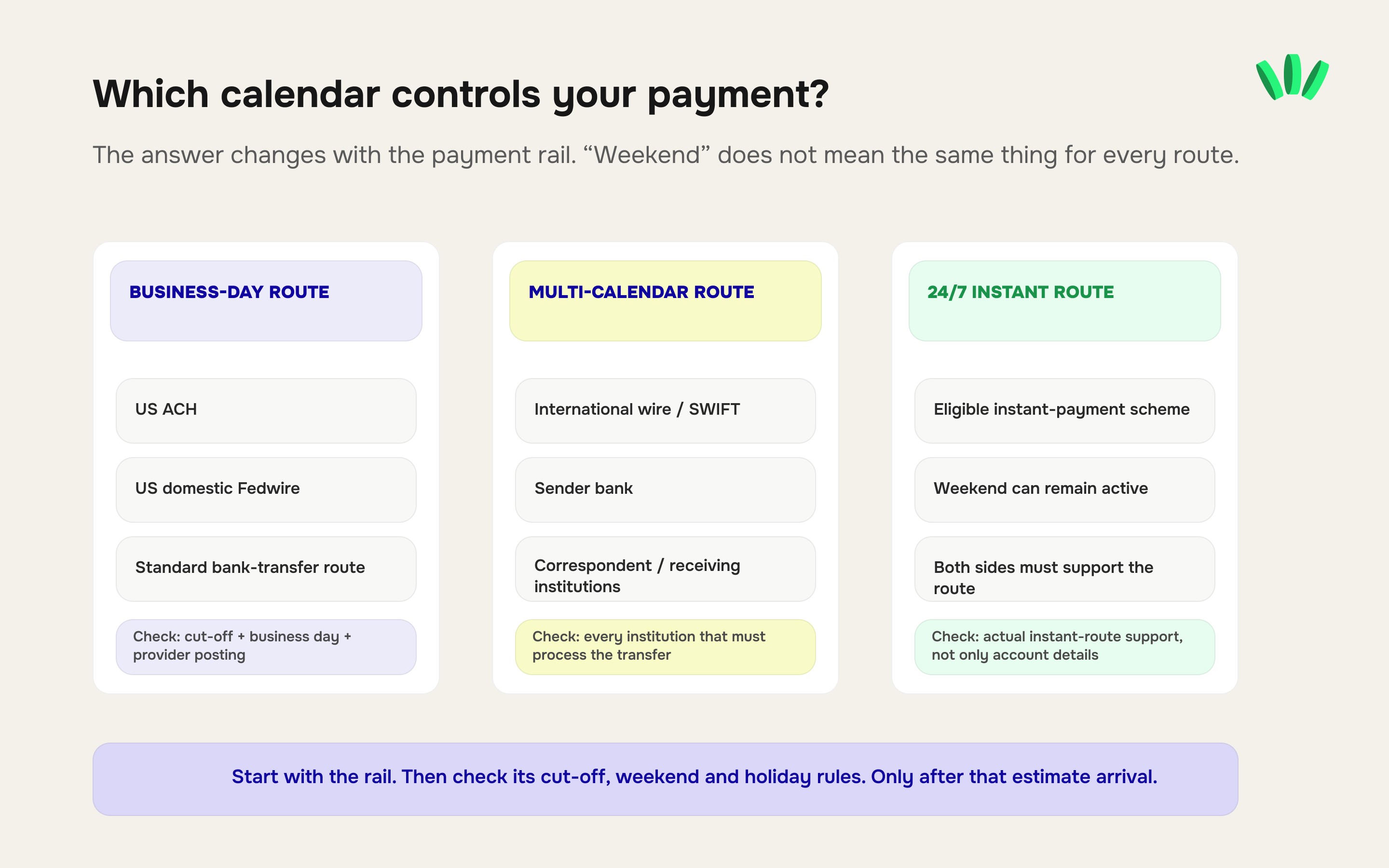
One Friday, five possible outcomes
Imagine the client clicks Send at 5:30 p.m. in their local time on Friday.
Situation | Reasonable interpretation |
Payment entered a supported business-day rail before the relevant cut-off | It may already be progressing on Friday |
Payment was entered after the sender’s Friday cut-off | The next eligible business day may become the effective starting point |
Monday is a relevant banking holiday | Tuesday may become the next processing day |
Payment uses a supported 24/7 instant route | It may continue through the weekend |
Payment has already entered review | The holiday calendar may no longer be the main cause of the delay |
The fifth case deserves attention.
A business-day delay and a payment review can look identical from your side: no money yet. They are not the same status.
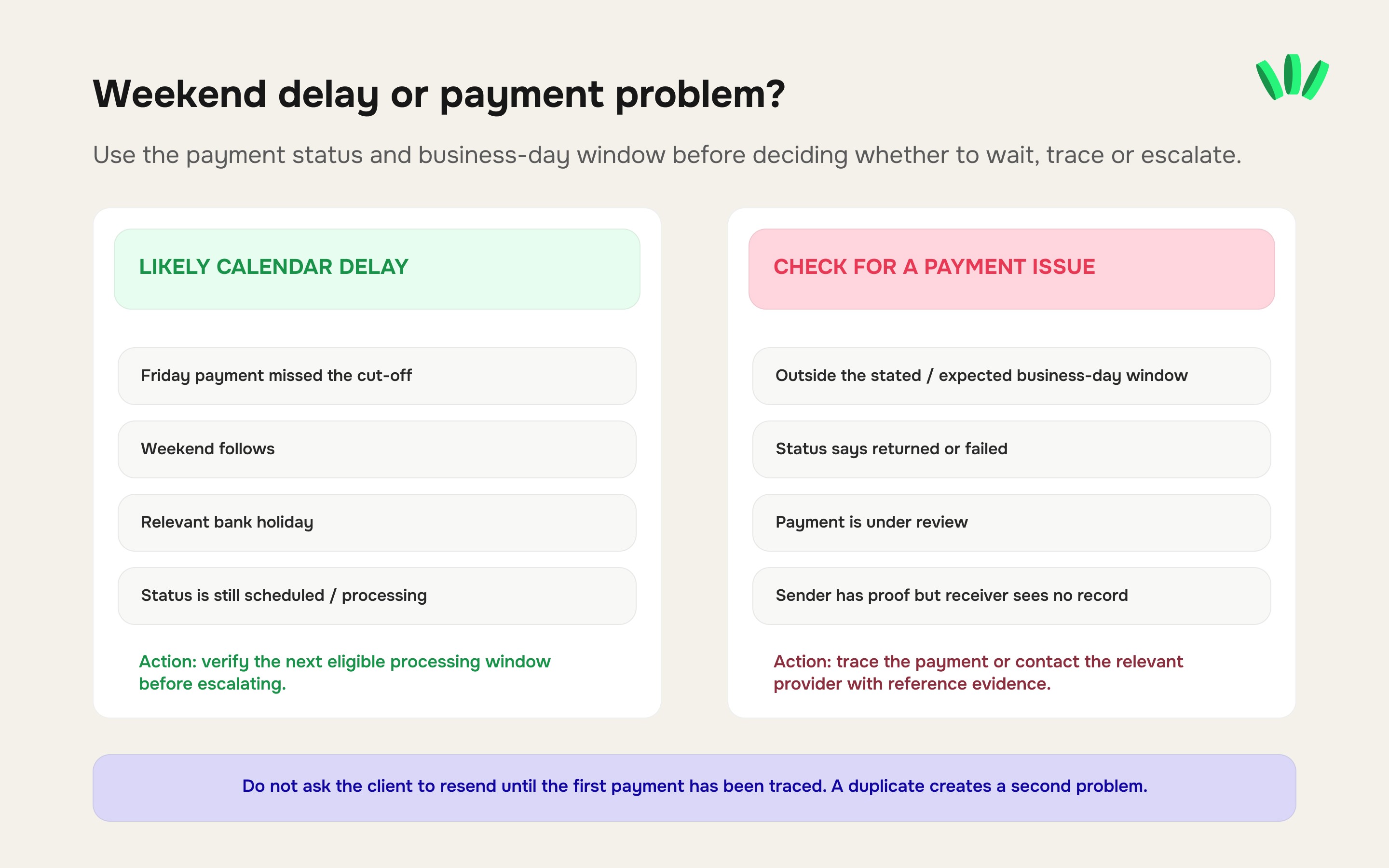
Weekend delay or payment problem? Separate the two
A payment being absent on Saturday is not automatically a problem. A payment still being absent after the expected business-day window deserves a different check. Separate these situations:
Situation | Start with |
Friday after cut-off, weekend follows | Calendar and processing window |
Relevant bank holiday | Holiday schedule |
Payment says pending at sender | Sender/provider status |
Payment says sent but no receiving record | Trace/reference information |
Payment says returned | Return reason/code |
Payment is under review | Provider review requirements |
Receiving details were incorrect | Payment instructions and return/trace path |
Client cannot identify the rail | Sender’s bank/payment provider |
If the payment has moved beyond a normal calendar delay, use the route-risk guide for freelance payments that are held, reviewed or delayed instead of continuing to wait for “the next business day.”
How to estimate a Friday payment without making a promise
Use a range, not a date you cannot defend. A practical timing model is:
Earliest realistic availability = next eligible processing window + rail settlement time + receiving-provider posting/review time
That is not a banking formula. It is a planning model. The useful inputs are:
1. Payment rail
ACH? Domestic wire? Standard SEPA? Instant payment? UK local transfer? International wire? This is the first variable.
2. Exact submission time
“Friday” is not precise enough. Ask for the time and time zone. Friday 9:00 a.m. New York and Friday 6:30 p.m. New York can produce different outcomes.
3. Sender’s cut-off
Did the payer meet the bank or provider’s cut-off for that route? The sender’s interface may show an expected processing or value date.
4. Relevant weekend and holiday calendars
Check the countries and institutions in the route. For a simple domestic US ACH, the US calendar dominates. For a cross-border wire, more than one banking calendar may matter.
5. Receiving-provider rules
When the underlying payment reaches the receiving institution, does your provider:
credit it immediately;
post on business days;
need to match a reference;
apply an account or transaction review?
6. Evidence
Keep:
invoice number;
amount;
currency;
payment method;
date and time submitted;
payer name;
bank/provider confirmation;
transfer or trace reference.
Those records allow you to stop guessing if the payment misses the expected window.
What should you ask a client who says “I paid Friday”?
You do not need a long interrogation. Ask for five pieces of information:
1. What payment method did you use?
ACH, domestic wire, international wire, SEPA, platform payout, or another method.
2. What exact date and time was it submitted?
Include the time zone.
3. What status does your bank show now?
Scheduled, pending, processing, sent, completed, returned?
4. What processing/value date does the bank show?
This can reveal whether Friday’s instruction became Monday’s payment.
5. What reference or trace information is available?
Keep it with the invoice.
Do not ask the client to resend immediately because the first transfer is not visible. Two payments are harder to reconcile than one late payment.
The invoice due date and the day you need the money should not be identical
If rent, payroll, a software renewal or another important expense is due Monday, a client initiating a business-day transfer late Friday is a fragile cash-flow plan. Your invoice may say:
Due Friday
but “due” is ambiguous unless the contract or payment terms establish whether it means:
client initiates payment by Friday;
client’s bank releases payment by Friday;
funds must reach your account by Friday.
For recurring clients, remove that ambiguity. You can write payment terms around the expected route and ask the client to initiate early enough for its normal processing window. That is more useful than sending increasingly urgent “has it gone through?” messages over the weekend.
Time zones create a hidden Friday problem
Nigerian freelancers often look at a client’s Friday through Nigerian time. The client does not.
A US client might still be in the middle of its workday when it is already evening in Lagos. A late-afternoon payment from the US can therefore arrive at the banking system much later than the freelancer intuitively expects. For each recurring client, record:
Client location
Usual payment rail
Their bank/provider cut-off if known
Normal invoice day
Relevant holiday calendar
You do not need to calculate this from scratch every month.
Bank holidays are route-specific, not freelancer-specific
If you are in Lagos and your US client is paying through a US banking route, a Nigerian public holiday does not automatically pause the US payment rail.
Likewise, Nigeria being open for business does not make a US banking holiday disappear. For international wires, more calendars can enter the route because correspondent and receiving institutions may sit in different countries. So before blaming “the holiday,” identify which institution was supposed to process the payment on that date. This is especially useful around:
long holiday weekends;
Christmas and New Year;
Easter;
national banking holidays;
mismatched holidays between the sender and receiver’s countries.
A backup payment route does not need the same calendar
There is a useful operational advantage to having more than one tested payment route. If your primary route depends on one banking calendar, a backup with exactly the same dependencies may not solve a holiday or outage problem. The goal is not to open five payment apps. It is to know which route can realistically take over when the primary route cannot perform the job.
The walllet.com guide to building a primary and backup freelancer payment route explains how to separate route redundancy from app collecting. Do not switch the current payment halfway through merely because another route looks faster. Use the backup for the next payment unless the institutions handling the existing transfer tell you otherwise.
When should you contact support?
Do not open a support case just because Saturday appeared on the calendar. Escalate when the payment is outside the provider’s stated or reasonably expected business-day window, when the status indicates a failure/review, or when the evidence contradicts what you should be seeing.
Before contacting support, have this ready:
payment rail;
currency and amount;
payer’s legal name;
date and exact submission time;
sender’s current status;
effective/value date if shown;
invoice reference;
bank/payment reference or trace number;
beneficiary details used;
screenshots that show relevant status, without exposing unrelated sensitive information.
Then ask a specific question:
Has this payment reached your receiving institution, or is it still outside your system?
That answer narrows the search.

