Choosing a crypto wallet in 2026 is about security, recovery, fees, and usability. Use this simple checklist to pick the right wallet without hype. The best wallet is the one you can trust with real money and still use on a bad day.
TL;DR
In 2026, “best crypto wallet” depends on what you’re doing: holding long-term, swapping often, using DeFi, or sending payments.
Start by choosing custody (custodial vs non-custodial), then pick a security + recovery model you can realistically handle.
Finally, check fees, networks, and day-to-day usability. Use the checklist below, score your options, and avoid wallets that hide pricing or make recovery a guessing game.
The Problem with “Best Crypto Wallet” Lists
Most “best crypto wallet” articles are built like a shopping shelf. You get a few names, a few features, and a winner. Real life is different. The wallet that looks perfect in a comparison can be painful when you lose your phone, send funds on the wrong network, a swap fails mid-transaction or makes you sign something you did not understand!
So instead of a hype list, let’s build a decision you can live with.
Related: Best Crypto Wallet for Beginners: What to Look for Before You Download Anything
Step 0: Decide What You’re Actually Using Crypto for
Before features, be honest about your behavior. Pick your main use case:
Long-term holding: You care most about security and recovery.
Swapping and moving funds often: You care about fees, speed, and fewer “stuck” moments.
DeFi and apps: You care about safe dApp connections, approvals, and smart wallet features.
Payments and daily use: You care about simplicity, stablecoins, and not needing “extra steps” every time.
You can do more than one, but choose your primary mode. It will decide the trade-offs you should accept.
The 2026 Checklist (score each wallet 0 to 2)
Give every wallet a score:
0 = unclear or weak
1 = acceptable
2 = strong and clearly explained
At the end, you will have a wallet that fits you!
1) Custody: who controls the keys?
This is the first gate.
Custodial wallet: a company controls the private keys. It can feel easy, but it is not full ownership.
Non-custodial wallet: you control the keys. You own it, and you also own the responsibility.
If you want “my crypto is mine,” you want non-custodial.
Quick test: If support can reset your wallet access like a password, it is usually custodial or semi-custodial.
2) Security model: what is the actual protection layer?
In 2026, wallet security is not just “seed phrase or not.” Common models you will see:
Seed phrase based self-custody (12–24 words)
Seedless wallets using passkeys or device security
MPC-based wallets (distributed key shares)
Smart wallets (account abstraction features like spending limits, batching, sponsored gas)
What you want is clarity. If the wallet cannot explain its security model in simple language, do not trust it with serious funds.
Related: How to Tell if a Crypto Wallet Is Safe Before You Use It
3) Recovery: what happens on your worst day?
This is the most ignored part of wallet selection. Ask yourself these questions:
If I lose my phone, can I recover?
If my phone is stolen, what stops a thief?
If I change phones, how hard is migration?
Do I need to store anything offline?
Is recovery step-by-step, or “contact support and hope”?
A strong wallet explains recovery like a flight safety card. Short, specific, and not scary.
Practical advice: Avoid wallets where recovery depends on you remembering a complex setup you will forget in six months.
4) Fees and pricing: can you predict what you’ll pay?
In 2026, “fees” can hide in multiple places: network fees (gas), swap execution price (spread), aggregator / routing fees, extra wallet fees or premium subscriptions. A good wallet is transparent about what it charges and what it does not charge.
If a wallet advertises “zero fees,” look for a clear explanation of what that means in practice.
5) Gas friction: do you need the native token every time?
A common beginner trap is needing ETH, MATIC, BNB, or another native token just to move funds. Modern wallets may support sponsored gas for some actions, paying gas in a different token (in certain flows) or clearer warnings before you get stuck. This is not just convenience. It is fewer failed transactions, fewer panicked searches, fewer mistakes.
6) Networks and assets: does it support what you actually use?
A wallet can be great and still not match your life. Always check:
the networks you use (Ethereum, major L2s, etc.)
the tokens you hold (stablecoins, majors, long-tail)
whether it handles cross-chain moves cleanly
Also check how the wallet behaves when a token is not recognized. A solid wallet helps you avoid fake tokens and scams.
7) Swaps and bridging: does it explain what’s happening?
If you swap often, your wallet should show the route clearly (at least at a high level) and minimum received and slippage settings, warn you when liquidity is thin and handle crosschain actions without turning into a puzzle. A wallet that hides details can make you feel safe while you are not.
8) DeFi safety: does it help you avoid “approval regrets”?
DeFi is where wallets become expensive if they are sloppy. Look for:
clear signature prompts
warnings for risky approvals
easy ways to review and revoke approvals
safe dApp connection flow
If you plan to use DeFi, do not pick a wallet that treats approvals like background noise.
9) Privacy: what do you have to give up to use it?
A wallet does not need your email or phone number to be usable. Some require it, some do not. Decide your comfort level:
Are you okay with email/phone sign-in?
Do you want “privacy by default” with minimal data collection?
Does the wallet explain what data it stores?
In 2026, privacy is part of security.
10) UX under stress: can you still use it when you’re anxious?
This is underrated. Your wallet will be used when you are nervous. A good wallet makes the next step obvious, warns you before risky actions, does not bury critical info in tiny menus and has simple language! If you feel confused during setup, you will feel worse during a real transfer.
A Simple Scoring Method that Actually Works
Make a shortlist of 3 wallets.
For each wallet, score the 10 checklist items (0–2).
Total max score: 20.
Then apply two filters:
Any wallet with a 0 on Recovery is out.
Any wallet with unclear Fees is out.
You will usually end up with one wallet that feels “boring but solid.” That is the one you want.
walllet.com Among the Best Crypto Wallets in 2026
If your priorities look like this:
non-custodial ownership
seedless onboarding (no phrase to write down)
passkey-style security and a setup that feels like a modern app
fewer friction points for swaps and moving funds
privacy-first onboarding (no email/phone)
…then walllet.com is naturally worth testing against this checklist.
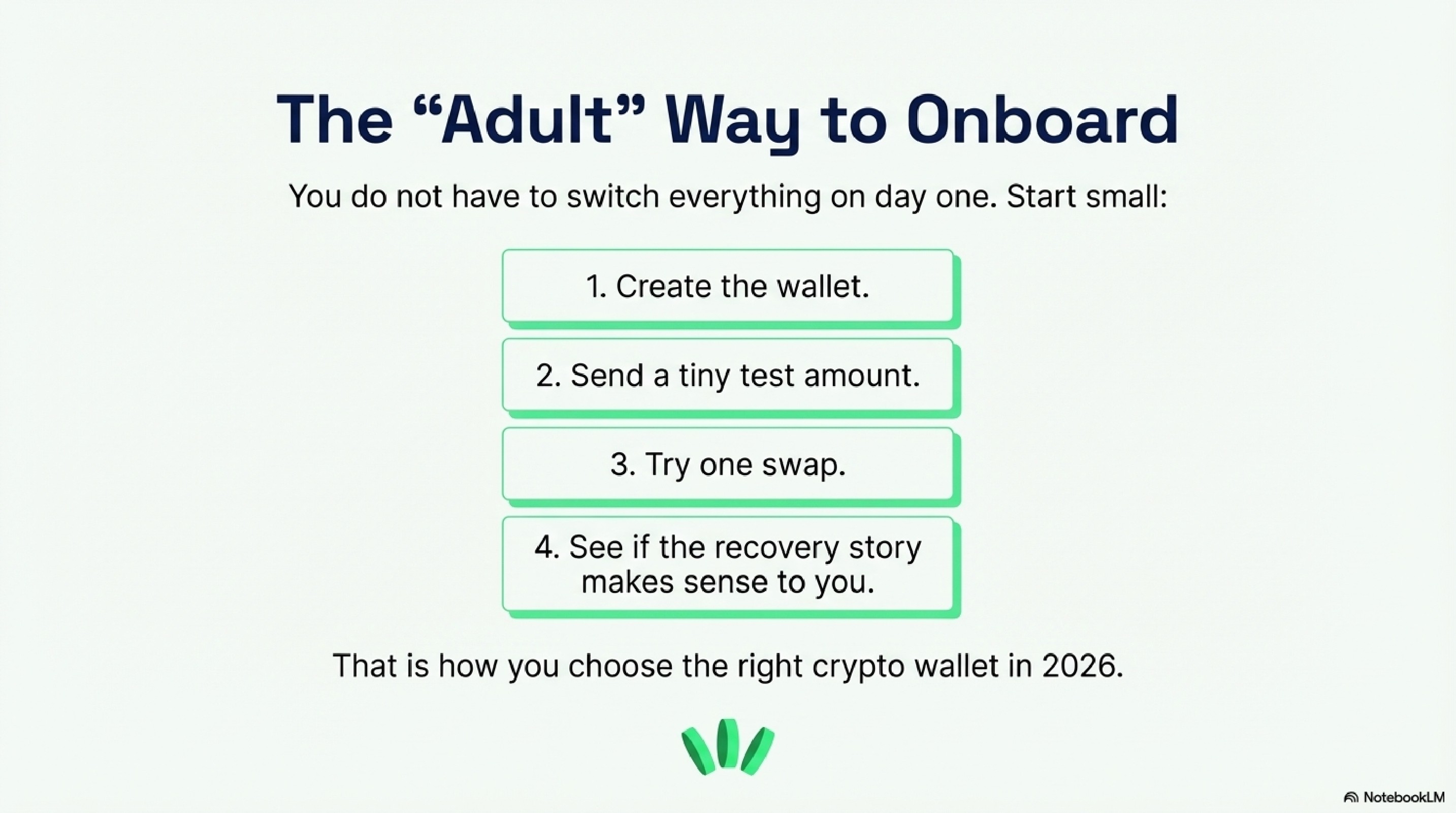
You do not have to switch everything on day one. Start small: 1- create the wallet. 2- send a tiny test amount. 3- try one swap. 4- see if the recovery story makes sense to you. That is how you choose the best crypto wallet like an adult in 2026.
The One Mistake to Avoid
Do not choose a wallet based on popularity alone.Choose it based on:
whether you can recover
whether you understand what you are signing
whether you can predict fees
whether it matches your real use case
If you get those right, “best crypto wallet” stops being a mystery and becomes a decision. Open walllet.com now and create your wallet in 2 minutes. Then fund it with a small test amount and run the checklist on your own experience.
