
There is no single winner between walllet.com, Grey, Raenest, Cleva and Payoneer. The answer changes with one question: who is paying you, and what do you need to do with the money after it arrives?
For a standard US ACH payment, Raenest currently publishes a $1 flat receiving fee. Cleva charges 0.8%, with a $2 minimum and $5 maximum, while eligible Upwork deposits are free. Grey charges 0.8%, with a $2 minimum and $10 maximum. Payoneer’s USD receiving cost depends on the receiving route, location and account. walllet.com currently lists a 1% fee for incoming USD through its supported bank route, plus a separate $5 account issuance fee.
That still does not tell you which route leaves you with the most usable money. Receiving fees are only the first deduction. The exchange rate, conversion fee, bank payout charge, card costs, payer restrictions and even the payment rail can change the result.
If the terms ACH, wire, SEPA and local receiving account are still blurring together, start with how Nigerian freelancers receive payments from US, UK and EU clients. If you are deciding what a dollar account needs before comparing brands, the more useful baseline is the 11 things that matter when choosing a dollar account in Nigeria.

The short answer: which provider fits which payment route?
Provider | Worth checking first when… | USD receiving route | Current published receiving fee | What happens after receipt |
walllet.com | You want receiving, USD holding, online spending and naira cash-out in one income flow, and the receiving route shown in your account fits your payer. | The exact rail is account- and eligibility-dependent; walllet.com says eligible users receive USD, EUR and GBP through account details in their own name. | Incoming USD through the supported bank route: 1%. Bank Account issuance: $5 one time. | Hold USD, use an eligible USD card, or convert/cash out to naira. Current off-ramp fee: 0.5%, separate from the exchange rate. |
Grey | Your payer uses ACH, FedNow or Fedwire and you also value USD, GBP and EUR receiving. | ACH, FedNow and Fedwire. | ACH/FedNow: 0.8%, min $2, max $10. Fedwire: $20. | USD→NGN conversion currently carries a 1% fee capped at $6; NGN bank withdrawal is ₦35. |
Raenest | A US client can pay by ACH, or you need an explicitly documented SWIFT route. | ACH, domestic wire and SWIFT. | ACH: $1 flat. Domestic wire: $10 flat. SWIFT cost depends on the sender’s fee arrangement. | USD→NGN: 0.5%, capped at $2.70, minimum $0.25. Nigerian bank payout: ₦0. |
Cleva | You receive eligible Upwork payouts, need FedNow, or want a low capped ACH receiving fee. | ACH, FedNow and US domestic wire; stablecoin deposits also supported. | ACH/FedNow: 0.8%, min $2, max $5. Upwork: $0. Wire: $10. | Cleva currently states no separate USD→NGN conversion fee. A statutory ₦50 stamp duty applies to qualifying transactions of ₦10,000+. |
Payoneer | The marketplace or client already supports Payoneer and you want its established marketplace payout network. | Local receiving accounts, payment requests and, where available, SWIFT receiving. | USD local receiving is generally 0–1% or 1% depending on location, currency and route. | Hold multiple currencies, convert, spend where card-eligible or withdraw to an approved bank account. Exact withdrawal fee and FX quote are shown for the applicable transaction. |
The table is deliberately conditional. A provider with a lower receiving fee can still produce a worse final result if its USD/NGN quote is weaker when you cash out. A provider with a higher receiving fee can make sense if it accepts the payer your cheaper option cannot. That is also why a generic “best payment app” ranking is usually a poor decision tool.
Compare the money route, not the app
A freelancer’s payment does not end when the USD balance appears. A useful comparison follows the full route:
Payer → payment rail → receiving fee → USD balance → hold/spend/convert decision → exchange rate → conversion fee → cash-out fee → final usable money
The sequence matters.
Suppose one provider charges $1 to receive $1,000 and another charges $8. The first provider starts $7 ahead. But if its conversion quote produces ₦20,000 less when you cash out, the cheaper receiving fee was not cheaper for your actual use case.
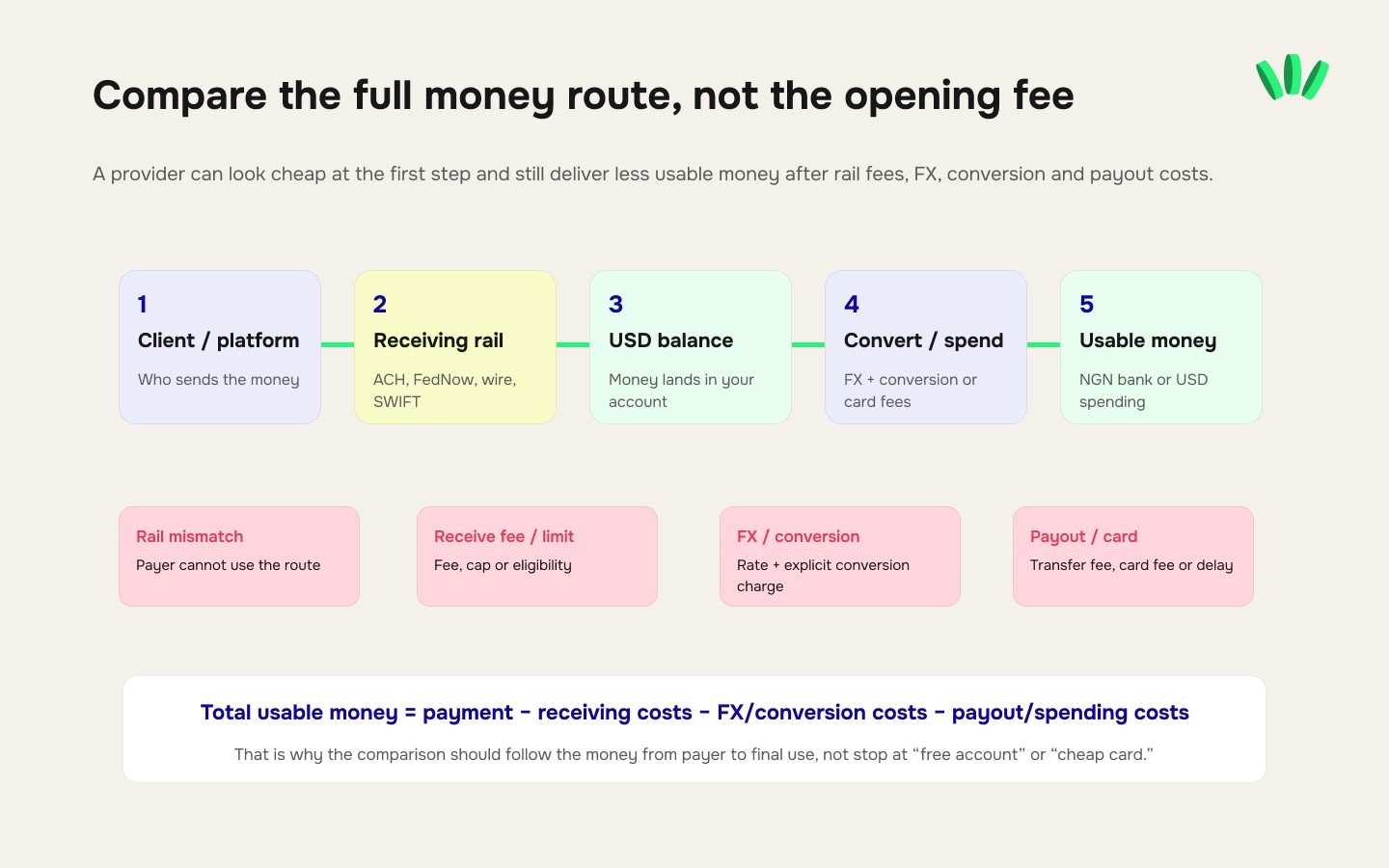
The same logic works in reverse. If you keep most of your income in USD and spend it on USD-priced software, hosting or subscriptions, a USD→NGN conversion fee may barely matter. Card fees matter much more.
That is why freelancers comparing payment setups should separate at least nine fields:
Field | What to verify |
Beneficiary/account details | Whose name appears, and what details must the payer enter? |
Payer fit | Direct client, employer, Upwork, marketplace, personal sender or your own account? |
Rail | ACH, FedNow, Fedwire, SWIFT, SEPA, FPS or another route? |
Receiving cost | Percentage, minimum, cap or flat fee? |
Holding | Can the income remain in USD or another foreign currency? |
FX | What executable rate is offered at the moment you convert? |
Explicit conversion charge | Is there a percentage or fixed fee in addition to the rate? |
Spending | Does the provider have an eligible card, and what does using it cost? |
Cash-out | What is charged to move the final naira to your Nigerian bank? |
For a wider comparison of bank-transfer and non-bank routes, see how to receive USD in Nigeria without PayPal.
If your payment route needs to cover more than the moment your client clicks “Send,” compare what your account can receive, keep, spend and convert before moving the invoice.
Check the payment route currently available to your walllet.com account

Direct US client: Grey, Raenest, Cleva, Payoneer or walllet?
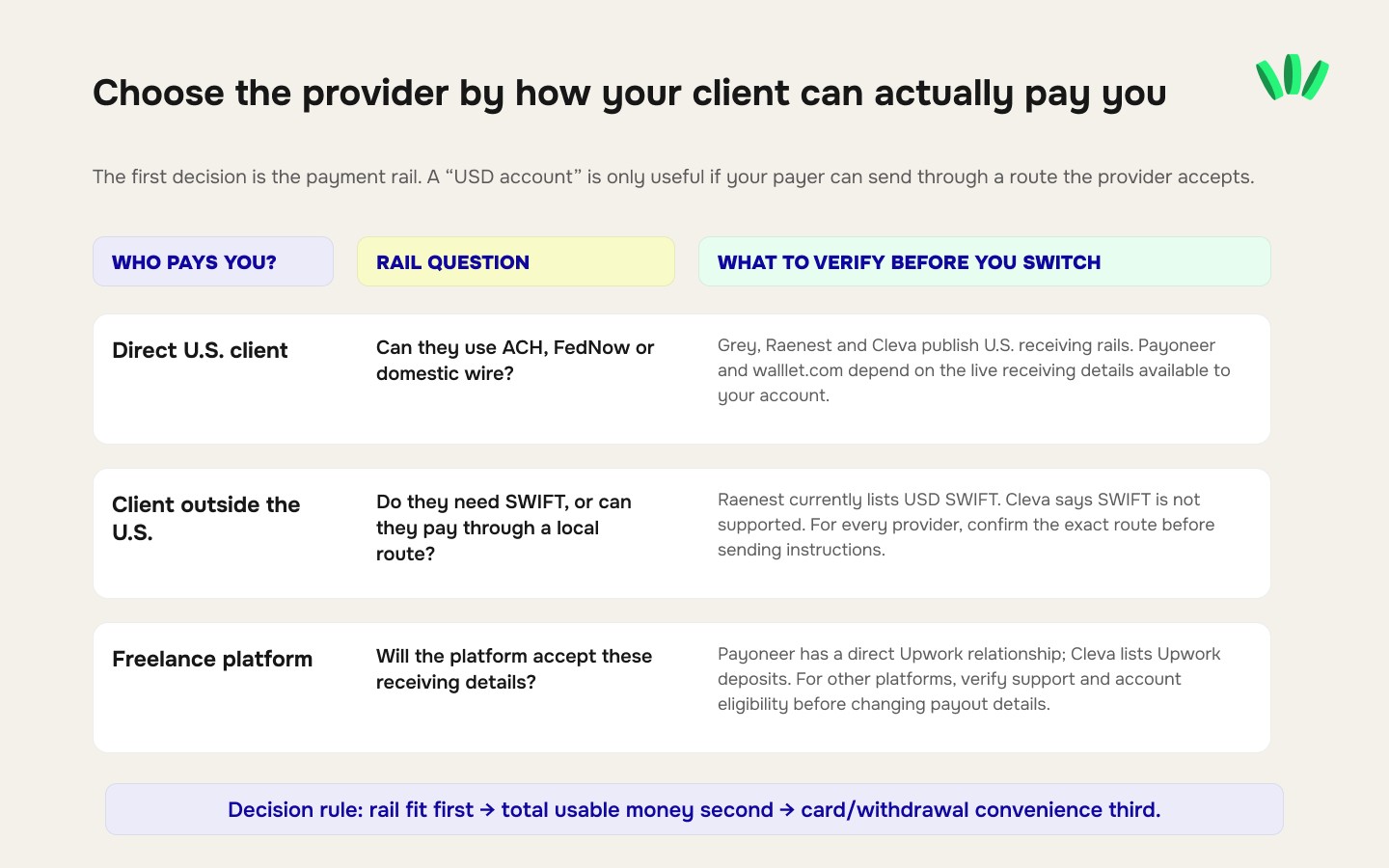
For a direct US client, the first question should be surprisingly boring:
How can their finance team pay you?
If the answer is ACH, several options work. If the client insists on FedNow, the field narrows. If they send a domestic wire, the fee structure changes again. If they are outside the US and can only send SWIFT, a US local receiving account may not solve the problem at all.
If your client pays by ACH
For a $1,000 ACH payment, the current published receiving fees are:
Provider | Published receiving fee on a $1,000 payment |
Raenest | $1 |
Cleva | $5 because the 0.8% calculation hits the $5 cap |
Grey | $8 |
Payoneer | Route/account dependent |
walllet.com | $10 for a $1,000 incoming USD payment through its supported bank route; confirm that the exact route shown to your account fits the client |
These are receiving costs, not total costs.
On pure published ACH receiving cost, Raenest has the lowest fixed fee among Grey, Raenest and Cleva at the time of this check. That does not automatically make it the cheapest route to naira.
If your client uses FedNow
Grey and Cleva both explicitly document FedNow receiving.
Grey applies the same 0.8% fee as ACH, with a $2 minimum and $10 maximum. Cleva also charges 0.8%, but caps it at $5. Grey describes FedNow receipts as settling in seconds to minutes when the sender’s bank supports the network; Cleva also supports FedNow through its USD account.
A freelancer cannot force a client’s bank to use FedNow. The payer’s bank must support it.
If your US client sends a domestic wire
Raenest currently publishes a $10 domestic-wire receiving fee. Cleva lists $10. Grey lists $20 for Fedwire.
This is a good example of why “I have US bank details” is incomplete information. The account may accept ACH but charge very differently for a wire.
If the client is outside the US and wants to send USD by SWIFT
Raenest explicitly documents a USD SWIFT receiving route. Payoneer also offers SWIFT receiving accounts where available.
Cleva needs more caution. Its current pricing page describes a $10 “wire” deposit and gives non-US banks as an example, but its May 2026 support documentation says wire receiving is limited to US banks and that SWIFT from non-US banks is not currently supported. The older SWIFT FAQ says the same. Because those official Cleva pages do not fully agree, a freelancer should verify the exact route inside the account before giving non-US wire instructions to a client.
That discrepancy is precisely why live product checks matter more than comparison blogs.
Platform payouts change the comparison
A direct client can often choose among several payment methods. A marketplace usually gives you a fixed list.
That changes the decision.
For example, Cleva currently charges $0 on eligible Upwork deposits. Raenest supports Upwork payout workflows. Payoneer and Upwork renewed a 15-year partnership in May 2026, with Payoneer continuing as a core wallet and Direct to Local Bank payout partner for international Upwork customers. Grey says platforms including Upwork commonly pay its USD accounts by ACH.
So for an Upwork freelancer, “Which app has the cheapest normal ACH fee?” is the wrong first question. The platform-specific payout route can override the standard fee table.
Payoneer is particularly relevant when a platform already treats Payoneer as a native payout option. Its advantage is not necessarily the lowest standalone percentage. It is the depth of its marketplace integrations and the fact that the platform may already know how to route the payment. Payoneer says its receiving accounts connect with 100+ marketplaces.
For a fuller look at how conventional platforms and stablecoin payments change the workflow, see PayPal vs Payoneer vs Wise vs stablecoins for freelancers.
Do you actually “own” the receiving bank account?
Do not infer legal account ownership from the presence of an account number and routing number. What a freelancer needs operationally is usually narrower:
What beneficiary name appears?
What bank and account details must the payer use?
Which rails can those details accept?
Which sender types are allowed?
Is the receiving service provided directly by a bank or through the fintech’s banking partner?
walllet.com currently says eligible users get USD, EUR and GBP account details in their own name, but it also states that walllet.com is a financial technology company rather than a bank and that accounts, cards and payments are provided through licensed partners.
Grey instructs users to share the account and appropriate ACH or wire routing details shown in the app. Payoneer makes the distinction unusually explicit: its receiving accounts function like bank accounts for receiving payments, but are not conventional standalone bank accounts.
For Raenest and Cleva, use the beneficiary and bank details displayed in the current account rather than assuming a generic account-ownership structure from a comparison page.
For invoicing, the safest practice is simple: copy the current beneficiary name, account number, routing details and payment instructions from the provider itself. Do not manually “correct” the beneficiary name to make it look more professional.
The $1,000 test: what is left before the exchange rate?
A fee comparison becomes more useful when every provider is run through the same payment.

Assume a Nigerian freelancer receives $1,000 from a US client through a standard eligible ACH-style route, then converts the entire available balance to naira.
We can compare the explicit published charges before applying the provider’s actual USD/NGN exchange rate.
Provider | After receiving fee | Explicit USD→NGN fee | Amount entering the FX result* | NGN payout charge |
walllet.com | $990.00 | $4.95 off-ramp fee | $985.05 equivalent | Included route must be checked in current quote |
Grey | $992.00 | $6.00 because the 1% fee reaches its cap | $986.00 equivalent | ₦35 |
Raenest | $999.00 | $2.70 because 0.5% reaches its cap | $996.30 equivalent | ₦0 |
Cleva | $995.00 | Cleva currently states no separate conversion fee | $995.00 equivalent | ₦50 statutory stamp duty can apply once the qualifying naira transaction reaches ₦10,000 |
Payoneer | Variable | Variable by route/account | Requires live quote | Requires live quote |
*This column is not final naira received. It deliberately excludes each provider’s live executable exchange rate. (walllet.com)
This table produces an important result: even after calculating all the visible percentage and flat fees, you still cannot name the cheapest final route.
If Provider A applies its conversion to $995 but offers a weaker executable exchange rate than Provider B converting $986, Provider B can still put more naira in your bank.
A serious comparison therefore needs a same-time FX quote.
How to calculate “total usable money” correctly
For a freelancer cashing out to naira, use:
Final usable NGN = money remaining after USD-side fees × executable USD/NGN rate − NGN-side payout and statutory charges
If the conversion fee is deducted in USD before conversion, subtract it before applying the rate.
For example:
Invoice amount: $1,000
Receiving fee: $5
USD remaining: $995
Conversion fee: $0
Executable provider rate: R
NGN-side charge: C
Then:
Final usable NGN = $995 × R − C
Do that calculation for every provider at approximately the same time.
Do not compare one provider using today’s live quote with another provider’s rate from yesterday. USD/NGN moves too much for that comparison to be useful.
A second metric is useful if you want to measure the entire route:
Route loss = benchmark value of invoice − final spendable value
This captures costs hidden inside an exchange rate as well as visible fees.
Grey: when does it make sense?
Grey is particularly easy to evaluate when the payer uses US banking rails because its documentation clearly separates ACH, FedNow and Fedwire.
Its current USD receiving fees are 0.8% with a $2 minimum and $10 maximum for ACH and FedNow, and $20 for Fedwire. Grey also receives EUR and GBP through their respective local rails.
Grey therefore makes more sense when:
your payer needs ACH or FedNow;
you receive across USD, EUR and GBP;
you prefer clearly documented payment rails;
its live FX quote is competitive when you actually need naira.
One limitation matters for direct personal payments. Grey currently caps individual third-party USD deposits at less than $4,000 per transaction, while its help centre says third-party deposits from business accounts do not have that limit.
That means a $5,000 invoice from a company and a $5,000 transfer from an individual client’s personal bank account may not be operationally equivalent.
Grey’s current USD→NGN conversion fee is 1%, capped at $6, with a ₦35 NGN bank withdrawal fee.
For spending, Grey currently lists virtual-card options with no routine maintenance, transaction or card-funding fee, although cross-border charges can apply. Card type and availability vary by region.
Raenest: when does it make sense?
Raenest currently has the simplest published standard ACH receiving price among the fixed-fee options in this comparison: $1 per eligible USD ACH payment, regardless of amount.
It also publishes separate domestic-wire and SWIFT receiving routes rather than collapsing every USD bank transfer under one label.
Raenest becomes particularly interesting when:
a direct US client pays by ACH;
you receive larger ACH invoices, because the $1 fee does not rise with the payment amount;
you need a documented SWIFT option for USD;
you want an explicit, capped USD→NGN conversion charge.
Its current USD→NGN conversion fee is 0.5%, capped at $2.70, with a $0.25 minimum. Nigerian bank payouts are currently listed at ₦0.
Limits still depend on verification. Raenest’s July 2026 KYC table shows different daily outflow limits by KYC level, even when the incoming-payment capability itself is available.
For online spending, Raenest currently lists a $3 one-time virtual USD card creation charge, $0.70 per successful transaction and additional international-merchant charges in applicable cases.
Cleva: when does it make sense?
Cleva’s strongest current pricing case is not its standard ACH rate. It is the combination of a $5 maximum ACH/FedNow receiving fee and $0 Cleva fee on eligible Upwork deposits.
For normal ACH and FedNow deposits, Cleva charges 0.8%, with a $2 minimum and $5 maximum. A $1,000 ACH payment therefore costs $5 rather than the mathematical $8. A $10,000 ACH payment still costs $5 under the current schedule.
Cleva also accepts business payments and certain third-party individual USD payments. Its current deposit policy caps third-party USD deposits from another individual’s personal bank account at $1,000 per day, while business payments and supported platform routes are treated separately.
That condition matters. A provider may happily accept a $5,000 payment from a client’s company account but reject the same amount when it arrives from the client’s personal checking account.
Cleva currently says it does not charge a separate USD→NGN conversion fee. Statutory charges can still appear on the Nigerian side, including ₦50 stamp duty on qualifying transactions of ₦10,000 or more.
For spending, the current Cleva Classic USD Card has a $3 one-time creation charge and spends directly from the USD wallet.
Its main routing caveat is international USD. Cleva’s current help centre says SWIFT transfers from non-US banks are not supported, despite wording on its pricing page that could be read more broadly. Treat the in-account payment instructions as authoritative before giving a non-US client wire details.
Payoneer: when does it make sense?
Payoneer is hardest to compress into one fee because its pricing changes with the payment method, currency, sender and recipient location.
Its current pricing page says receiving through a receiving account in a currency that is not your local currency generally costs 1%, with a minimum fee, while other receiving scenarios can be free or use different pricing. Payoneer explicitly warns that fees depend on sender and recipient locations, method and currencies.
That variability is a reason to avoid copying one Payoneer percentage into every Nigeria comparison.
Payoneer becomes particularly relevant when:
your marketplace directly offers Payoneer;
you already receive from several platforms into the same Payoneer balance;
you need local receiving accounts in several currencies;
you need an established marketplace payout ecosystem rather than only a US account number.
Its Upwork relationship is a concrete example. Payoneer and Upwork renewed their 15-year partnership in May 2026, and Payoneer remains a core wallet and Direct to Local Bank payout partner for international Upwork customers.
Payoneer receiving accounts can support currencies including USD, EUR and GBP, and eligible users can convert balances or withdraw to registered bank accounts. The actual fee and FX details should be taken from the transaction quote shown to the user.
That makes Payoneer a poor candidate for a universal “$X per $1,000” line without knowing the account and route.
walllet.com: when does it make sense?
walllet.com is positioned around the entire income route rather than one receiving rail.
On walllet.com site users can receive USD, EUR and GBP into account details in their own name, keep income in USD, use an eligible USD card for supported online payments and convert to naira when needed. The exact receiving route depends on what is available in the user’s account.
Its current published bank-account pricing is:
Bank Account issuance: $5 one time
Incoming USD through the supported bank receiving route: 1%
Off-ramp: 0.5%, charged separately from the USD/NGN rate.
For a $1,000 incoming USD payment, that means $10 is deducted as the receiving fee and $990 remains. If the whole $990 is later off-ramped, the 0.5% fee is $4.95, leaving $985.05 equivalent before applying the actual USD/NGN rate. The $5 account issuance fee is a one-time setup cost and should not be incorrectly charged against every future invoice.
The current virtual USD Mastercard costs $5 to issue. Card top-ups carry a 0.5% fee; USD card transactions carry a 1% fee subject to a $1 minimum and $10 maximum. Card availability and acceptance remain eligibility- and merchant-dependent.
That makes walllet.com less compelling if the only metric is the smallest published ACH-style receiving fee. Its commercial case is different: can one route handle enough of receiving, USD holding, online spending and naira cash-out to reduce the number of separate services you maintain?
For freelancers who sometimes receive stablecoins as well, the cash-out decision has its own cost structure. The operational steps are covered in how to cash out USDT or USDC to naira in Nigeria.

Which provider fits a direct client, and which fits a platform?
A simple decision matrix is more useful than a five-place ranking.
Your situation | Start your comparison here | Why |
US client pays by normal ACH | Raenest, Cleva, Grey, then any eligible walllet/Payoneer route | All three publish clear ACH pricing; Raenest currently has the lowest fixed standard ACH receipt fee. |
Client’s bank wants FedNow | Cleva or Grey | Both explicitly support receiving through FedNow. |
US client insists on domestic wire | Raenest or Cleva, then Grey | Current published receiving fees are $10, $10 and $20 respectively. |
Non-US client must send USD by SWIFT | Raenest or an eligible Payoneer SWIFT receiving account | Both explicitly document SWIFT receiving; Cleva currently says SWIFT is unsupported. |
Upwork is your main income source | Cleva, Payoneer, Raenest, then compare other available bank routes | Cleva currently lists eligible Upwork deposits at $0; Payoneer is an established Upwork payout partner; Raenest supports Upwork workflows. |
You frequently receive USD, GBP and EUR | Grey, Raenest, Payoneer or eligible walllet.com multi-currency details | Multi-currency receiving becomes more important than one USD fee. |
You want one workflow from income to USD spending to naira | Compare walllet.com, Cleva, Grey and Raenest using the full route | Card pricing, FX and payout become as important as receiving. |
You already depend on several international marketplaces | Payoneer deserves separate consideration | Existing marketplace integration can matter more than a small difference in bank-deposit fees. |
This matrix is based on current provider documentation, not a claim that one brand is categorically superior.
Which comparison fields can change by eligibility?
Almost all of them. Two people using the same provider may not have identical:
receiving currencies;
bank partners;
routing details;
transaction limits;
permitted sender types;
card access;
withdrawal limits;
KYC tier;
platform compatibility;
country availability;
review requirements.
Cleva, for example, displays deposit limits according to the user’s account and applies separate rules to personal third-party deposits. Raenest ties transaction limits to KYC level. Payoneer describes receiving and withdrawal features as eligibility-dependent. walllet.com instructs users to confirm the currency, rail, beneficiary name, sender types, limits and review rules currently shown for their account.
This is why screenshots from another user are weak evidence for a payment setup. Your own approved account details are stronger evidence.
Payment failures matter as much as pricing
The cheapest route is useless if your client’s transfer keeps returning. Before sending a new client an account, check:
exact beneficiary name;
ACH versus wire routing number;
sender type restrictions;
third-party payment rules;
supported country;
expected payment purpose;
payment reference requirements;
platform rules.
If an ACH payment is returned, do not keep resending it blindly. The return code can identify problems such as an invalid account number, closed account or other routing issue. The practical troubleshooting flow is in the guide to ACH return codes for freelancers.
What should you migrate before switching payment providers?
Do not close an old payment account the same day you open the new one. Treat a provider switch like changing the bank details of a small business.
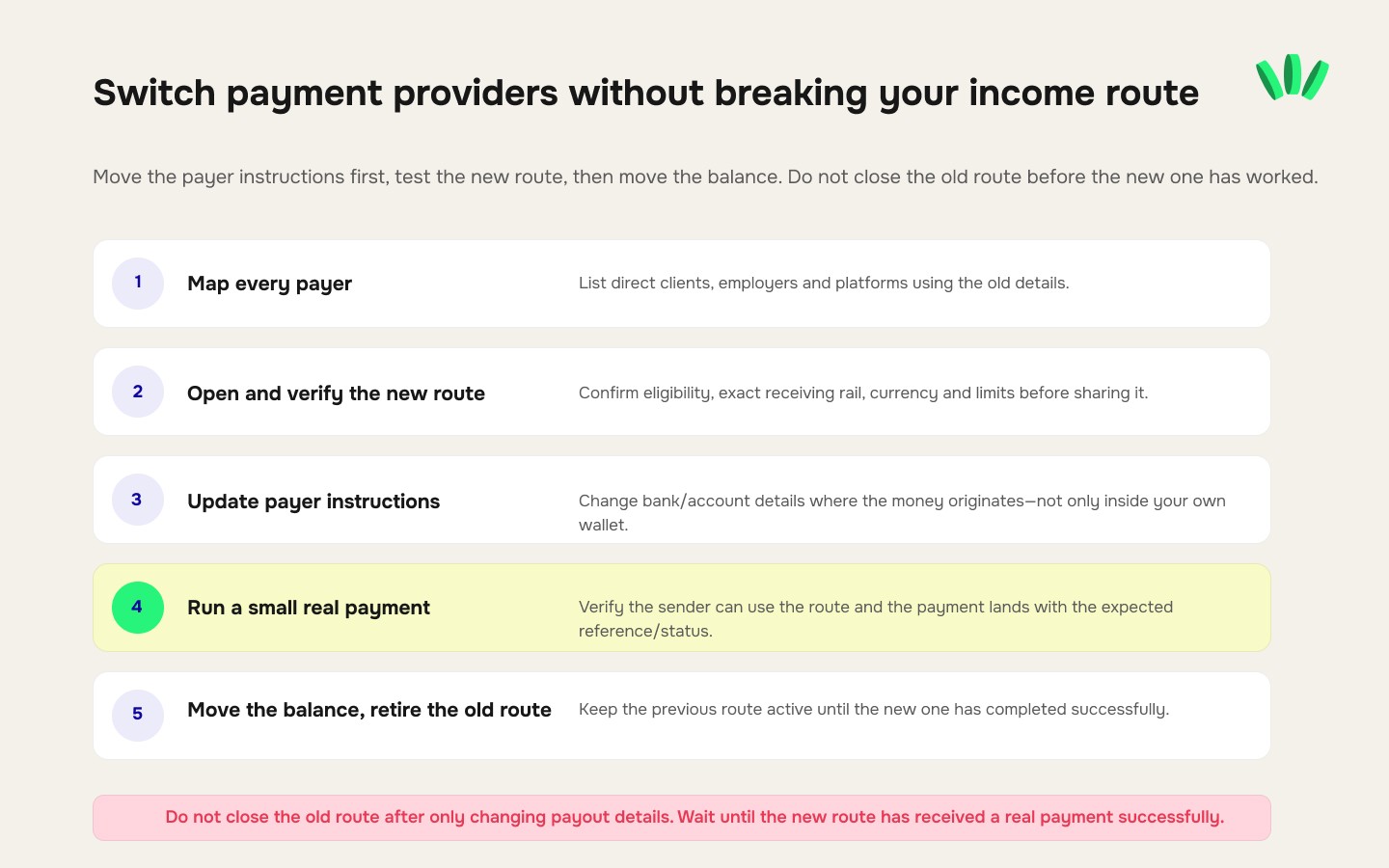
1. Map every place that sends you money
Record every direct client, employer, payroll system and marketplace using the old details.
A payment route you remember only after the old account stops receiving is the expensive one.
2. Export your records first
Download statements, transaction histories, payment confirmations and any documents you may later need for accounting, source-of-funds checks or client disputes.
3. Complete verification before moving your payers
An account showing a dashboard is not the same as a fully usable receiving route.
Confirm that the new account is approved, the intended currency is available and the payment rail you need is active.
4. Test the new route with one payer
Do not change ten clients at once.
Use one normal payment first. Confirm that it arrives, check the fee, test the conversion quote and, if naira cash-out matters, test a small payout.
5. Update platforms separately
Upwork, payroll providers and marketplaces may each have their own bank-verification or cooling-period rules.
Do not assume that changing an invoice template automatically changes your marketplace payout account.
6. Keep the old route alive while outstanding payments clear
An invoice sent three weeks ago may still contain the old details.
Grey’s own account-migration documentation offers a useful real-world example: when users received new US account numbers, Grey explicitly told them to update clients, employers and platforms because payments sent to obsolete details could be reversed.
7. Migrate subscriptions only after the new card works
If you also change cards, list recurring payments such as hosting, design tools, AI subscriptions, advertising and cloud services.
Move them one by one. Keep enough balance on the old card until you know nothing important still bills it.
8. Keep the old statements
A provider you no longer use can still be part of your tax, accounting or client-payment history.
Save the records before closing access.
So which one should a Nigerian freelancer choose?
Choose the route, not the logo.
For a US client paying by ACH, Raenest’s current $1 flat receiving fee deserves attention. For eligible Upwork payments, Cleva’s $0 deposit fee materially changes the calculation. For FedNow, Cleva and Grey are the clearly documented options in this group. For explicitly documented international USD SWIFT receiving, Raenest and eligible Payoneer receiving accounts stand out. For deep marketplace integration, Payoneer remains difficult to ignore.
walllet.com should be judged by a slightly different test: whether the receiving details available to your account fit the payer and whether keeping USD, paying online and cashing out to naira in the same workflow produces a better overall result for the way you use your income.
If two providers both accept your payer, compare them using one real invoice amount and live quotes on the same day. That gives you the number that matters:
How much usable money do I end up with?
If your receiving route matches the payer, walllet.com lets eligible users manage the next parts of the income journey too: hold earnings in USD, use an eligible USD card for supported online spending, see the rate and fee before converting, and cash out to naira when needed.
See the receiving and money route currently available to your walllet.com account

