
A client asks for proof that the bank account is yours. Your accountant asks for a record of last month’s payments. A compliance team asks for evidence of one $2,000 transfer.
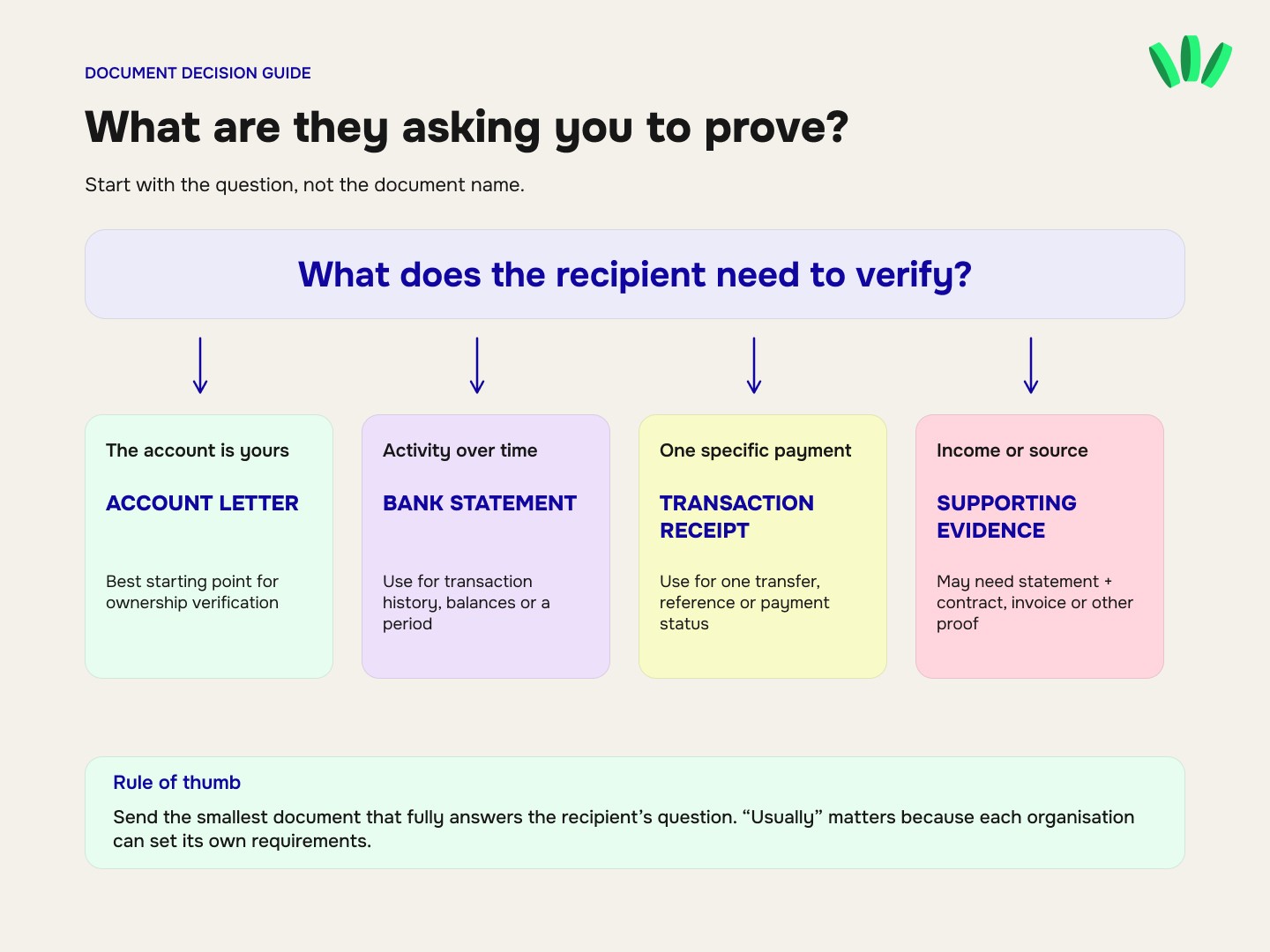
Those are three different requests. Sending the same screenshot for all three can create more questions than it answers. The simplest way to choose the right document is to ask one thing: what exactly does the recipient need to verify?
If they need to verify... | Usually send... |
The account belongs to you | Account letter or proof of account ownership |
Your transactions over a period | Bank statement |
One specific payment or transfer | Transaction receipt or transfer confirmation |
A request for payment | Invoice |
Your income | Often a statement plus supporting documents such as contracts or invoices |
Source of funds | Documents depend on where the money came from |
“Usually” matters here. A client, bank, visa office, payment provider, accountant, or compliance team can set its own document requirements.
What is the difference between an account letter, bank statement and transaction receipt?
An account letter proves that an account is associated with you and confirms key account details.
A bank statement shows activity in the account over a period of time, including transactions and usually balances.
A transaction receipt or transfer confirmation focuses on one specific payment and records details such as the amount, date, currency and reference number.
Providers may use slightly different names. Some, for example, call its document a “proof of account ownership,” while others offer an “account confirmation.” Both are designed to confirm information about the account rather than provide a complete transaction history.
Document | What it proves best | What it usually shows | Best used for | What it does not prove well |
Account letter | Account ownership and account details | Name, account details, provider, currency or identifiers | Client onboarding, account verification, payroll setup | Transaction history |
Bank statement | Activity over a period | Credits, debits, dates, balances, references | Accounting, income history, financial review | Details of one payment as clearly as a dedicated receipt |
Transaction receipt | One transfer or payment | Amount, date, currency, status, reference, parties where available | Payment confirmation, support cases, disputes | Overall account history or financial position |
Getting paid globally is easier when the payment route is clear before the paperwork starts. With walllet.com, eligible freelancers can receive global income, hold digital dollars, spend online, and cash out to naira when they need it.
Build a cleaner way to get paid

What is an account letter?
An account letter is a document issued by a bank or financial provider confirming information about your account. Depending on the provider, you may see names such as:
account confirmation letter
proof of account ownership
bank confirmation letter
account verification letter
proof of bank details
The exact document name matters less than what the recipient wants it to prove.
In some services customers could download a proof of account ownership document when a merchant or company needs confirmation that particular account details are associated with the customer. Some others’ account confirmation includes the account holder’s information and account identifiers such as IBAN, BIC and account numbers.
What does an account letter usually contain?
The fields vary by bank or provider, but an account confirmation document may include:
account holder name
account number or masked account number
IBAN, routing details or other bank identifiers
currency
bank or provider name
account status or account type
issue date
provider identification, signature or stamp where applicable
Do not assume every provider includes every field. If a client has given you a checklist, compare the document against that checklist before sending it.
When might someone ask for an account letter?
A company may request one when it needs to verify where it is about to send your money.
For a Nigerian freelancer working with a US company, this might happen during vendor onboarding. The client already has your routing and account numbers, but its finance team wants an official document showing that those details belong to you. That is an account ownership problem. A 25-page transaction statement gives the client far more information than it needs. An account letter is often the cleaner document for:
client or vendor onboarding
payroll setup
account ownership verification
adding payout details to a platform
compliance reviews focused on bank ownership
What does an account letter not show?
An account letter normally does not provide a detailed record of your spending, incoming payments or historical balances. If someone asks, “Show me the payments you received from March to June,” an account letter does not solve that problem. They are asking for transaction history. That is where a bank statement becomes more useful.
What is a bank statement?
A bank statement is a record of activity in an account during a defined period.
A statement normally shows the account holder, statement period and transactions recorded during that period. Depending on the bank or provider, it may also include opening and closing balances, account identifiers and payment references.
Some services statements, for example, contain transactions for the selected period, while others currency statements can include account-holder information, account details, balance information and completed, pending or reverted transactions.
What does a bank statement usually show?
A typical statement may include:
account holder name
account number or partial account number
statement period
opening balance
closing balance
credits
debits
dates
transaction descriptions
payment references
sender or recipient information where available
Think of a statement as a timeline. If you received four client payments in August, the statement can show those four credits in the context of the rest of the account activity.
When might you need a bank statement?
A statement can be useful when the request concerns a period rather than a single event.
For example:
A client has paid you $1,200 every month for six months, and you need to show recurring income.
An accountant needs to reconcile payments against your invoices.
A financial institution asks for evidence that money entered your account.
A landlord, lender or visa process asks for financial records.
A compliance team reviews the movement of funds.
Acceptance is never universal. A bank statement that works for bookkeeping may not meet a visa office’s requirements, and a statement that proves money entered your account may not be enough to explain where that money came from.
For a deeper breakdown of those distinctions, see Proof of Income vs Proof of Funds vs Source of Funds in Nigeria.
What is a transaction receipt?
A transaction receipt or transfer confirmation records one specific payment. If your question is: “Did the $1,500 payment from this client arrive?”
you usually do not need to send an entire month of personal transactions. A payment document may show:
amount
currency
payment date or time
transaction or reference ID
sender details
beneficiary details
payment status
payment method or transfer rail
The exact fields depend on the bank, payment platform and transfer type. Proof of one payment is different from a general statement covering weeks or months of account activity.
When is a transaction receipt the better document?
Use a transaction-specific document when the conversation itself is about one transfer. Imagine this support ticket:
My client sent $2,300 on Monday, but I cannot see it in my account.
A transaction receipt containing the payment reference, amount, date and beneficiary details gives support staff a much cleaner starting point than an unrelated account letter. If the payment is missing, delayed or disputed, keep the transaction reference. It is often one of the most useful pieces of information for tracing a transfer.
For missing-payment cases, see Payment Support Escalation: What to Send for a Missing Transfer.
Bank statement vs account letter vs transaction receipt
The same document can sometimes support more than one claim, but each document has a different job.
Question | Account letter | Bank statement | Transaction receipt |
Proves account ownership? | Strong | Often | Limited |
Shows multiple transactions? | No | Yes | No |
Makes one payment easy to identify? | Usually no | Sometimes | Yes |
Shows balance history? | Usually no | Often | No |
Useful for client bank verification? | Often | Sometimes | Usually not |
Useful for bookkeeping? | Limited | Yes | Yes |
Useful for investigating one transfer? | Limited | Useful supporting evidence | Usually the best starting point |
Exposes unrelated transactions? | Usually no | Often yes | Usually no |
The best document is the one that answers the recipient’s actual question with the least unnecessary information.
What if someone asks for “proof of bank account”?
Start by determining whether they mean proof of ownership.
If they need evidence that the account belongs to you, an account confirmation letter or proof-of-account-ownership document is usually more direct than a full bank statement. If the request is unclear, ask:
“Do you need proof of account ownership, transaction history, or proof of a specific payment?”
That one question can prevent several rounds of rejected documents. It also protects your privacy. There is little reason to expose a month of personal transactions if the recipient only needs your name and bank details. If the request concerns the details a foreign client needs to pay you, see ACH or Wire? The Bank Details Your US Client Needs Are Not the Same.
What if they ask for “proof of payment”?
A transaction receipt or transfer confirmation is usually the logical starting point.
But “proof of payment” can mean different things to different organizations. Some, for instance, may accept a bank statement or online-banking screenshot in some proof-of-payment cases, provided the document contains the required payment information. A dispute may require more evidence:
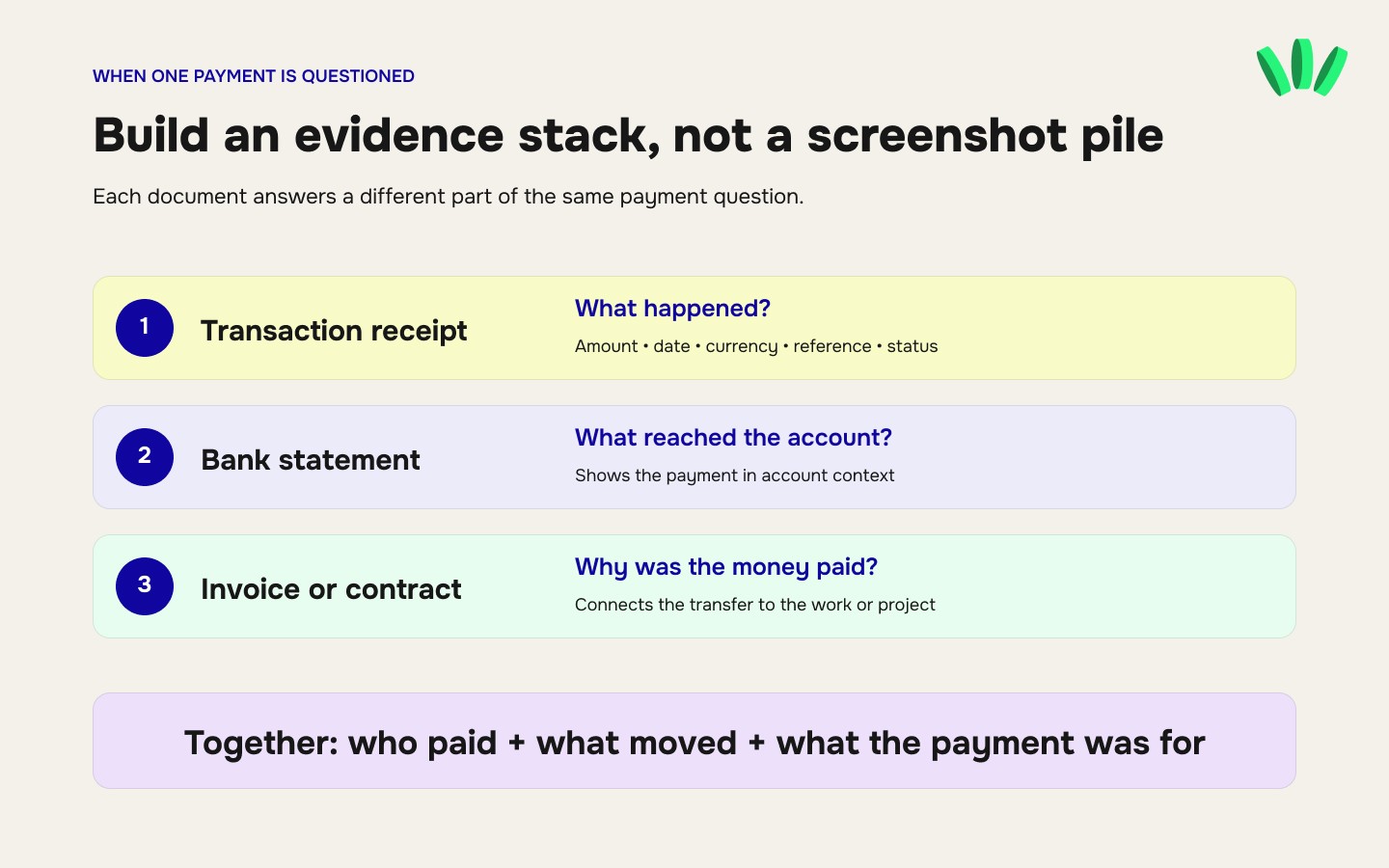
Transaction receipt + bank statement + invoice or contract
The receipt identifies the transfer. The statement can show what happened in your account. The invoice or contract explains the business reason for the payment. That combination tells a much clearer story than sending random screenshots without context.
Invoice vs transaction receipt: don’t mix them up
An invoice says:
Please pay me this amount for this work.
A transaction receipt says:
This payment was made or processed.
If you send a $2,000 invoice to a client, the invoice does not prove the client actually paid the $2,000. Likewise, a bank transfer receipt may show that $2,000 moved, but it may not explain which project, milestone or invoice the payment relates to.
Keep both.
For freelancers with several clients, matching invoice numbers to transaction references can save a lot of time later when an accountant, platform or compliance team asks about a payment.
What if compliance asks where the money came from?
That request is broader than “show me the transaction.”
A bank statement can show that money entered your account. It does not always prove the underlying source or economic reason for the funds.
For freelance income, supporting evidence might include a contract, platform earnings statement, invoice or other documentation connecting the payer, work and payment. Some services, for example, list different evidence requirements depending on the source of income and may require contracts, earnings statements, tax documents or bank records. Do not guess what a compliance team means by “proof of funds,” “proof of income” or “source of funds.” Those terms answer different questions.
See Proof of Income vs Proof of Funds vs Source of Funds in Nigeria for the full distinction.
What should Nigerian freelancers keep after every international payment?
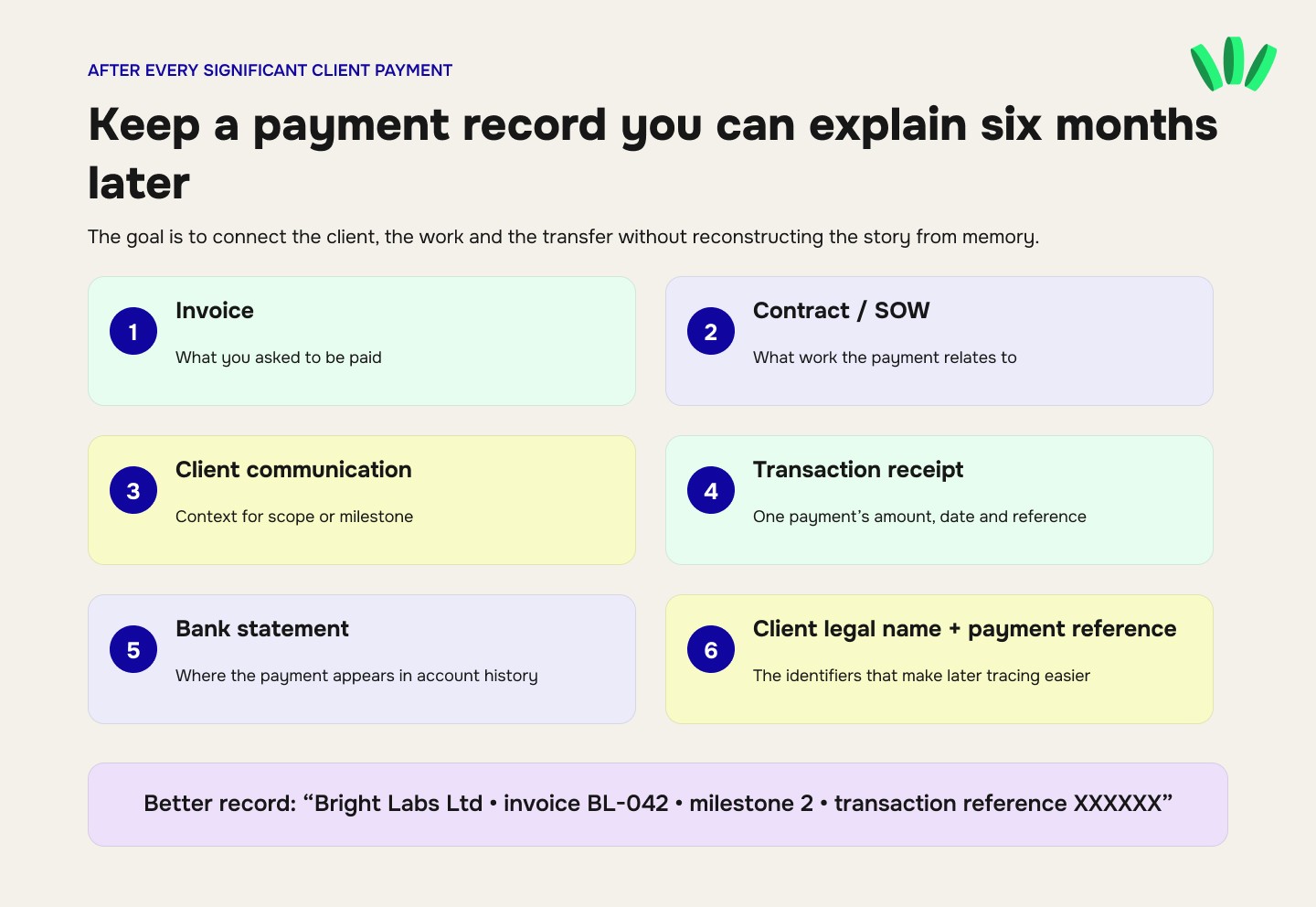
You do not need to build a compliance folder after something goes wrong. Keep the evidence while the project is still fresh. For each significant client relationship, save:
The invoice.
The contract or statement of work.
Relevant client communication.
The transaction receipt or payment confirmation.
The bank statement covering the payment.
The transaction or payment reference.
The client’s legal name or company name.
A short description of the work connected to the payment.
Suppose a client called Bright Labs pays you $3,200 for a product-design milestone. Six months later, someone asks what that payment was.
“Bright Labs, $3,200” is weaker evidence than:
Bright Labs Ltd, invoice BL-042, product-design milestone 2, contract dated May 3, transaction reference XXXXXX.
Good records reduce ambiguity.
Can you redact information before sharing a financial document?
Sometimes, but the recipient decides what must remain visible.
If they only need proof of account ownership, there may be no reason to send a full transaction statement at all.
If you do need to send a statement, ask whether unrelated transactions or part of an account number can be redacted. Never change amounts, dates or other information to make the document say something it did not originally say.
Some verification processes explicitly require complete documents. If the recipient asks for the original, full or unredacted document, send that version through the approved secure channel.

Is a screenshot enough?
Sometimes. Sometimes it is exactly what gets your document rejected.
For a simple question about one transfer, a screenshot that clearly shows the required transaction information may be accepted by the recipient. Some explicitly accept certain screenshots as proof of payment in some cases.
For more formal income verification, the rules can be stricter. Sometime an online-banking screenshot is not sufficient and downloaded or bank-issued statements for some income types are useful. That is why “Can I send a screenshot?” has no universal yes-or-no answer.
Check what the recipient asked for.
A simple document decision tree
What are they asking you to prove?
Account belongs to you → Account letter / proof of account ownership
Several transactions or a period of financial activity → Bank statement
One specific transfer → Transaction receipt / transfer confirmation
A request for payment → Invoice
Income or source of money → Statement plus the appropriate supporting documents
Bank details needed for an international payment → See Bank Details for International Payment
Timing of an international transfer → See How International Transfer Business Days Really Work
Before sending any financial document, identify what the recipient is trying to verify: your account, your transaction history, or one specific payment. Sending the smallest document that fully answers that question is usually clearer, faster and more private. Good records help you prove where a payment came from. A better payment setup makes the next payment easier to receive in the first place. Manage your global income with walllet.com, from receiving and holding digital dollars to spending online and cashing out in Nigeria.
Turn your next client payment into a simpler workflow

