To swap USDT to WBTC, choose USDT as the asset you spend and WBTC as the asset you receive. Before confirming, check the network, token contract, quoted output, minimum received, slippage, gas fee, and approval. WBTC is wrapped Bitcoin, not native BTC, so make sure you understand what you’re receiving.
TL;DR
WBTC is not native Bitcoin. It is a wrapped token that represents Bitcoin on another blockchain.
Before swapping USDT to WBTC, check the token, network, contract address, slippage, gas, and approval.
USDT exists on multiple networks, so “I have USDT” is not enough. You need to know which network your USDT is on.
The safest first move is usually a small test swap, especially if you’re using a new wallet, route, or network.
If the app makes the transaction hard to understand, slow down before signing.
Swapping USDT to WBTC sounds simple. You spend a stablecoin, you receive wrapped Bitcoin. Done.
Except not quite.
The important part is not only the conversion rate. It is whether you understand which WBTC you are receiving, which network it will live on, what fees affect the final amount, and what approval you are signing.
If you’re still unclear on the difference between a normal swap and a cross-chain route, start with walllet’s swap and bridge guide. It explains the basic difference before you get stuck staring at a swap screen like it owes you money.
Can you buy WBTC with USDT?
Yes. You can buy WBTC with USDT through a centralized exchange, a DEX, a DEX aggregator, or a wallet-based swap flow.
In a wallet, “buy WBTC with USDT” usually means swap USDT to WBTC. You already hold one crypto asset, USDT, and you exchange it for another, WBTC.
USDT is a dollar-pegged stablecoin. WBTC, or Wrapped Bitcoin, is a tokenized version of Bitcoin built for use on Ethereum-style networks and DeFi apps. If you want a deeper explanation of the asset itself, read walllet’s guide to what WBTC is and why Wrapped Bitcoin exists.
Here’s the practical difference between common routes:
Route | What happens | Main thing to check |
Centralized exchange | You trade USDT for WBTC inside an exchange account | Withdrawal network and custody |
Same-chain DEX swap | You swap USDT to WBTC on one network | Token contract, liquidity, slippage |
Cross-chain route | Your swap also moves value across networks | Route, bridge risk, fees, time |
Wallet-based swap | You swap from inside your wallet | Approval, gas, output, network |
The safest question is not “How fast can I convert?” It is: Do I understand what I am about to receive?
What is WBTC in simple terms?
WBTC is wrapped Bitcoin. It is a crypto token that represents Bitcoin on another blockchain, usually so Bitcoin value can be used in DeFi, swaps, lending apps, and smart contract ecosystems.
The official WBTC site says every WBTC is backed 1:1 by Bitcoin held in custody and verifiable through on-chain proof of reserves. That still does not make WBTC the same as native BTC.
Native BTC lives on the Bitcoin network. WBTC lives as a token on another blockchain. It can be useful, but it comes with a different trust model, different network rules, and different transaction costs.
A simple way to think about it:
WBTC gives you Bitcoin-like exposure inside DeFi. Native BTC gives you Bitcoin on the Bitcoin network.
Both can be useful. They are not the same thing.
What should you check before swapping USDT to WBTC?
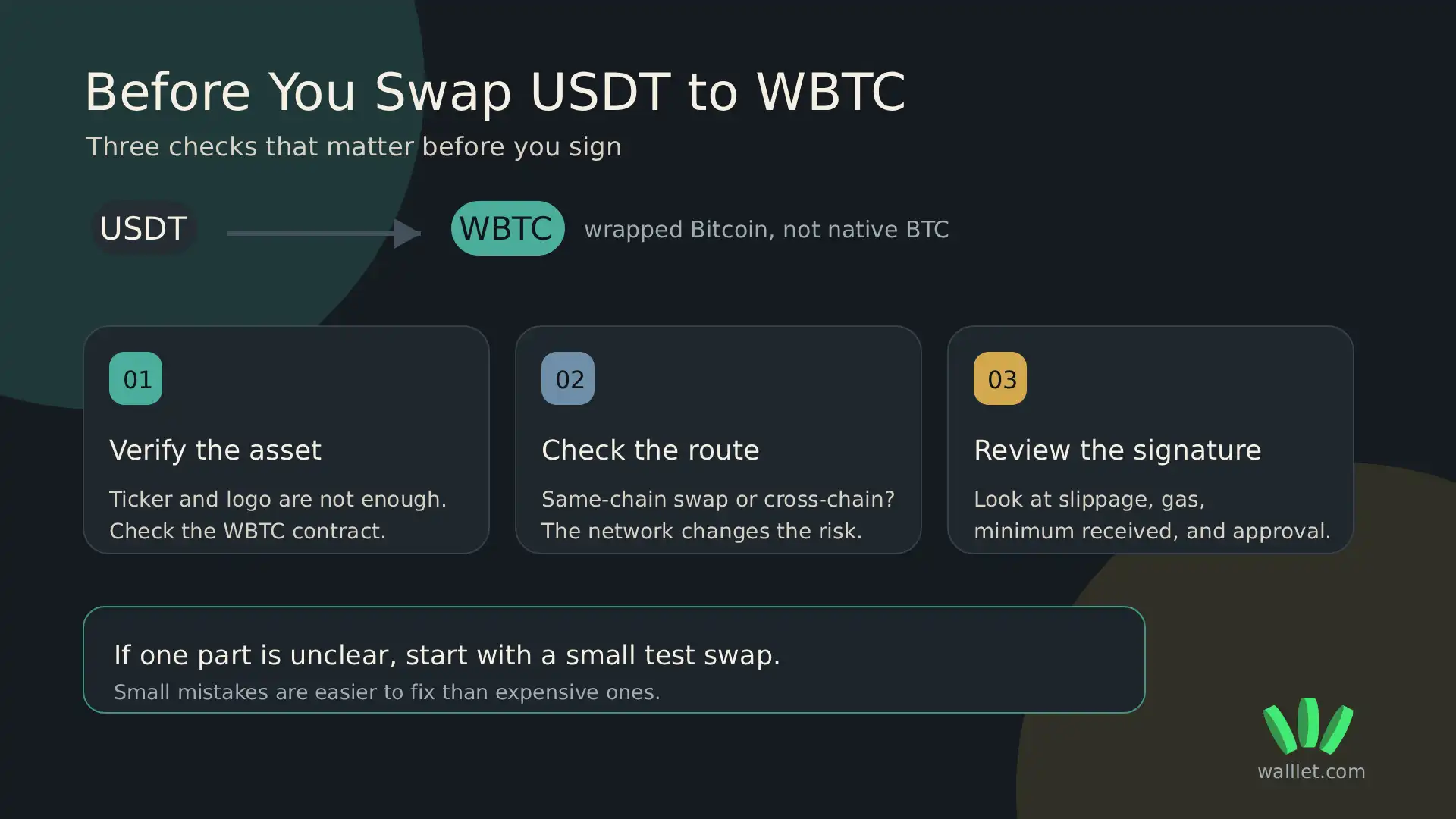
Before swapping USDT to WBTC, check the token, network, contract address, quote, minimum received, slippage, gas fee, and approval.
You do not need to become a protocol engineer. Mercifully. You just need a calm checklist.
Check | What it means | Why it matters |
Token | USDT in, WBTC out | Avoid receiving the wrong asset |
Network | Source and destination chain | Avoid wrong-network mistakes |
Contract | Verified WBTC address | Avoid scam or copycat tokens |
Quote | Expected WBTC output | Know what you should receive |
Minimum received | Lowest accepted output | Protect against bad slippage |
Approval | Permission given to a contract | Avoid risky token access |
First, check that the asset is actually WBTC. Do not trust the ticker alone. Names, logos, and symbols can be copied. The contract address matters. If you see several similar-looking WBTC tokens, stop and verify the token before swapping. walllet.com has a separate guide on how to verify a token contract before you buy or swap.
Second, check which network your USDT is on. USDT exists on several blockchains, including Ethereum, Tron, Solana, Avalanche, BNB Smart Chain, TON, Aptos, Tezos, Liquid, and others listed by Tether’s supported protocols page.
So “I have USDT” is only half the sentence. The missing half is: on which network?
USDT on Tron is not the same route as USDT on Ethereum. USDT on BNB Smart Chain will not magically become WBTC on Ethereum unless the swap route supports that movement.
Why slippage and price impact matter
Slippage is the difference between the price you expected and the price you actually get. Price impact is the effect your own trade has on the market or liquidity pool. Price impact is caused by your trade changing the pool price, while slippage is the gap between the expected price and the execution price.
For a small swap, this may barely matter. For a larger swap, or a low-liquidity route, it can matter a lot.
Before confirming, look at two numbers:
Expected output: how much WBTC the app estimates you will receive.
Minimum received: the lowest amount you agree to accept after slippage.
If those two numbers are far apart, pause. The swap may still work, but you need to understand the tradeoff. Curious what a clearer swap screen should help you check before signing? Explore walllet with a small amount first.
Do you need gas to swap USDT to WBTC?
Usually, yes. A swap needs a blockchain transaction, and blockchain transactions need network fees.
The gas token depends on the network. On Ethereum, you usually need ETH. On BNB Smart Chain, you usually need BNB. On other networks, the fee model may be different. This is one reason swaps confuse normal users. You may have enough USDT for the swap, but not enough of the network’s native token to pay the fee. Wonderful little design choice, obviously.
Some smart wallet flows can reduce gas friction, but you should still check what fee is being paid, which asset pays it, and whether the transaction can fail because of gas.
What approval are you signing?
A token approval gives a smart contract permission to use your tokens. Many swaps require an approval before the actual swap happens. Approvals are normal in DeFi. The risky part is approving the wrong contract, approving too much, or approving something without understanding it. Before signing an approval, check:
Which token is being approved
Which contract is receiving permission
Whether the approval amount makes sense
Whether the app or route is trusted
If the approval looks unclear, do not rush. A failed swap is annoying. A bad approval can be much worse.
Is WBTC the same as BTC?
No. WBTC is not the same as native BTC. WBTC is a wrapped token that represents Bitcoin on another blockchain. Native BTC is Bitcoin on the Bitcoin network. WBTC is a token that is minted after Bitcoin is held by a custodian, and burned when users convert it back through the system. That means WBTC can be useful if you want Bitcoin exposure inside DeFi. But if your goal is to hold native Bitcoin directly, WBTC may not be the asset you actually want. The tradeoff is simple:
Asset | Where it lives | Best for |
BTC | Bitcoin network | Holding native Bitcoin |
WBTC | Ethereum-style and supported networks | Using Bitcoin value in DeFi, swaps, and apps |
When should you not swap USDT to WBTC?
Do not swap USDT to WBTC if you cannot understand the route, the token contract is unclear, the price impact is high, or the approval looks risky.
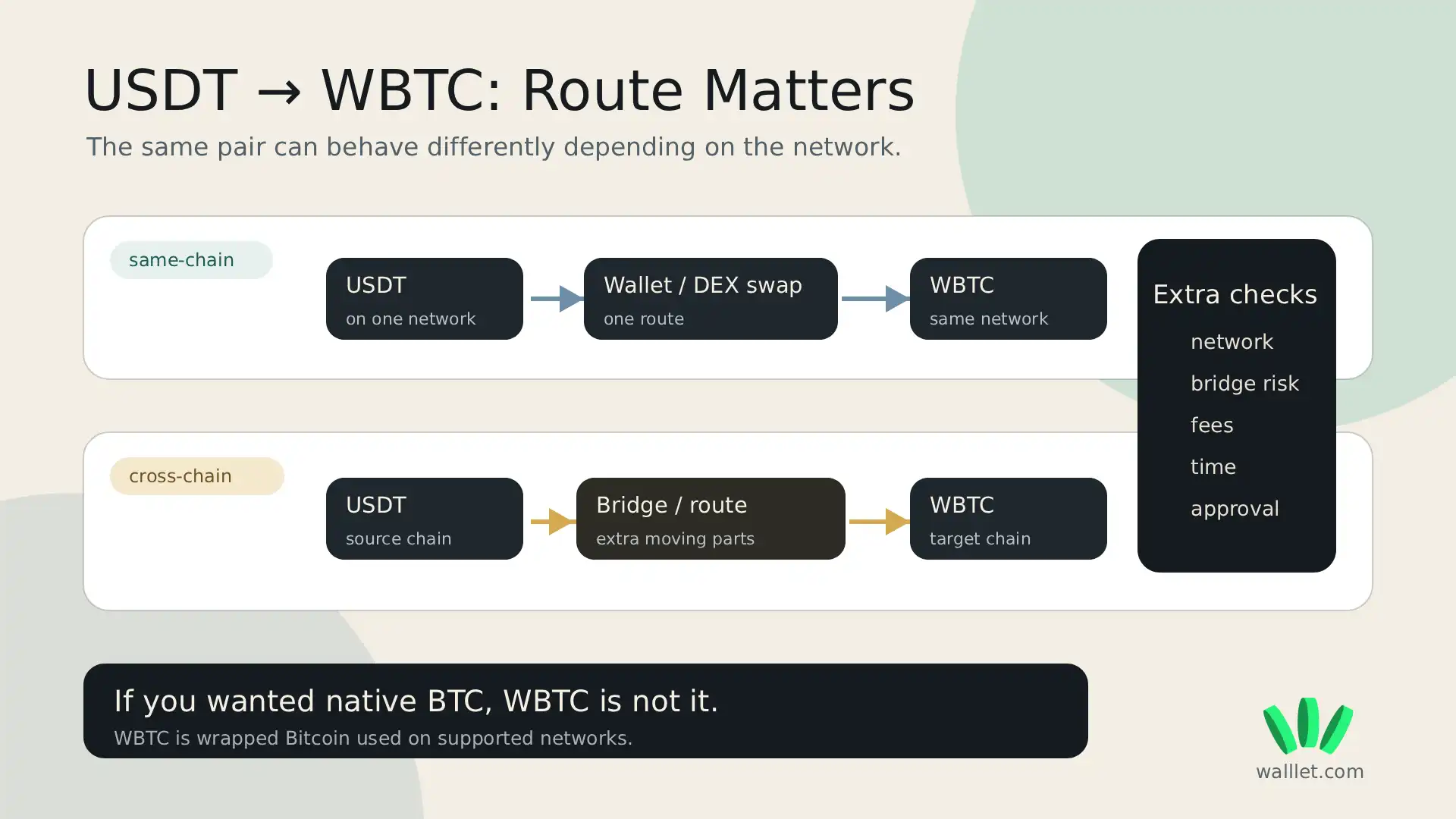
Also avoid the swap if you actually want native BTC. WBTC can track Bitcoin exposure, but it is still a wrapped token. A simple rule:
If you cannot explain what will happen after you press confirm, you are not ready to press confirm.
That does not mean you should never swap. It means the swap screen should make sense before you sign.
If a swap fails, do not keep retrying blindly. Check the reason first. It may be slippage, liquidity, gas, route expiry, unsupported token behavior, or a wrong network issue. walllet’s guide on why swaps fail covers the most common causes.
How can a wallet make USDT to WBTC swaps easier to understand?
A wallet cannot remove every swap risk. But it can make the decision clearer before you sign. walllet.com is a seedless self-custodial crypto wallet built to help people control crypto without managing a seed phrase. For swaps, the useful part is clarity: readable transaction prompts, suspicious-contract warnings, risky approval awareness, and a simpler way to understand what you are about to approve.
That matters when you are swapping USDT to WBTC because several things can go wrong at once: wrong network, fake token, unclear approval, high slippage, or a route you do not understand.
The goal is not to make users feel like experts. The goal is to help them avoid obvious mistakes before they become expensive ones.
What is the safest way to start?
The safest way to start is with a small test swap. Use a trusted app or wallet. Confirm that your USDT is on the right network. Verify the WBTC token. Check the quote, minimum received, slippage, gas fee, and approval. Then try a small amount first.
If the result looks right, you can decide what to do next. Ready to test swaps with more clarity? Create your walllet and check token, network, output, gas, and approval before you confirm.
