Before you swap USDT to USDC, make sure the move solves a real problem instead of just giving you a smaller balance with a cleaner label.
A USDT to USDC swap makes sense when you need USDC for a specific app, payment route, wallet feature, card flow, or exchange deposit. Before swapping, check the network, final received amount, gas fee, swap fee, slippage, approvals, and whether keeping USDT is cheaper.
TL;DR
Swap USDT to USDC only when USDC helps you do something specific.
USDT and USDC both aim to track $1, but swapping between them is not always free.
Always check the final amount you’ll receive, not just the exchange rate.
Same-network swaps are usually simpler than cross-chain swaps.
Avoid the swap if the destination already accepts USDT or the fees are bigger than the benefit.
A USDT to USDC swap looks simple because both tokens are dollar-pegged stablecoins. In practice, it is still a crypto transaction. That means network fees, swap fees, slippage, approvals, and sometimes bridge risk can all affect what you actually receive.
If you’re still getting familiar with stablecoins, start with how stablecoins work. If you already understand USDT and USDC and just want to know whether the swap is worth it, this guide is for that moment right before you approve.
So can you swap USDT to USDC? You can. But first ask yourself: Should I swap right now, on this network, with this route, for this final amount?
When does it make sense to swap USDT to USDC?
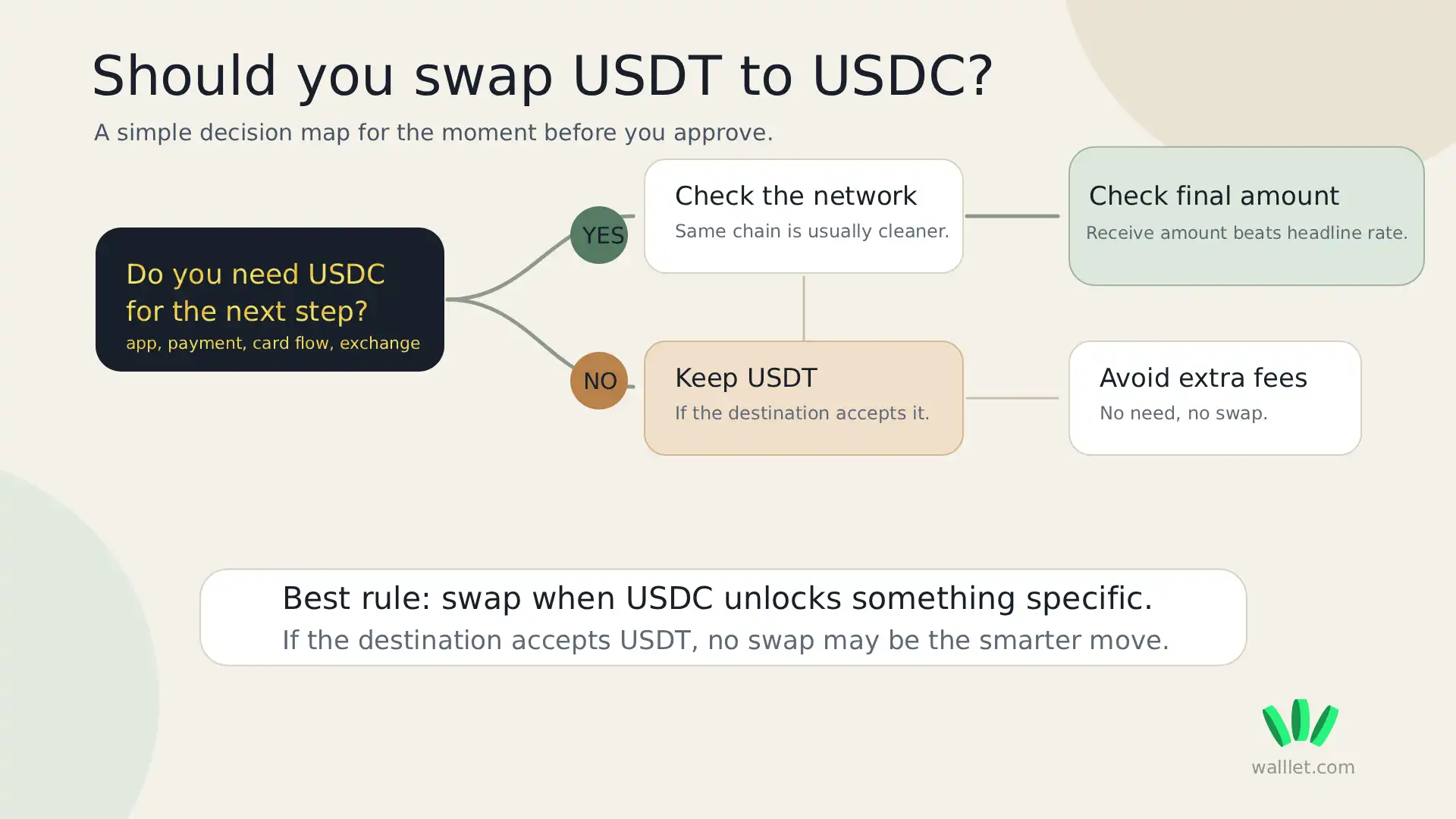
A USDT to USDC swap makes sense when USDC is required or clearly better for your next step. That could mean:
You need USDC for a specific app, protocol, exchange, payment route, or spending flow.
You’re using a service that supports USDC more smoothly than USDT.
You want to move into a USDC-based card or payment setup.
You prefer USDC’s issuer structure and transparency model for this particular use case.
Circle says USDC is fully backed by highly liquid cash and cash-equivalent reserves and publishes reserve information for transparency. Tether says USDT tokens are pegged 1:1 and backed by Tether’s reserves. Both have different issuer models, reporting practices, and trust assumptions, so the right choice depends on what you need the token for.
For freelancers and remote workers, this can be very practical. If you receive USDT from a client but the tool you want to use next needs USDC, a swap may be useful. In Nigeria and South Africa, stablecoin demand has been growing strongly, and Reuters reported in 2026 that 95% of Nigerian respondents in one stablecoin study preferred receiving payments in stablecoins instead of local currency.
So, yes, swapping can make sense. But only when it solves a real problem.
What should you check before swapping USDT to USDC?
Before you swap, check where your USDT is, where your USDC needs to go, how much you’ll receive, and what you’re approving.
Check | Why it matters | Good sign | Warning sign |
Network | USDT and USDC exist on many chains | You can swap on the same network | You need to bridge and don’t understand the route |
Final amount | Fees may reduce what you receive | The received USDC amount is clear | Only the exchange rate is shown |
Gas fee | Every onchain action may need network fees | Gas is small compared with the swap | Gas costs more than the benefit |
Slippage | The executed price may differ from the quote | Slippage is low and visible | Slippage is hidden or too high |
Approval | Some swaps ask for token permissions | The permission is limited and clear | The approval feels broad or confusing |
The important thing is simple: don’t approve a swap until the final received amount makes sense.
A stablecoin swap is not automatically free just because both tokens aim to equal one dollar. Curious what this looks like in a wallet built around clearer crypto actions?
How much does a USDT to USDC swap cost?
A USDT to USDC swap can include gas fees, swap fees, slippage, price impact, platform fees, and bridge fees.
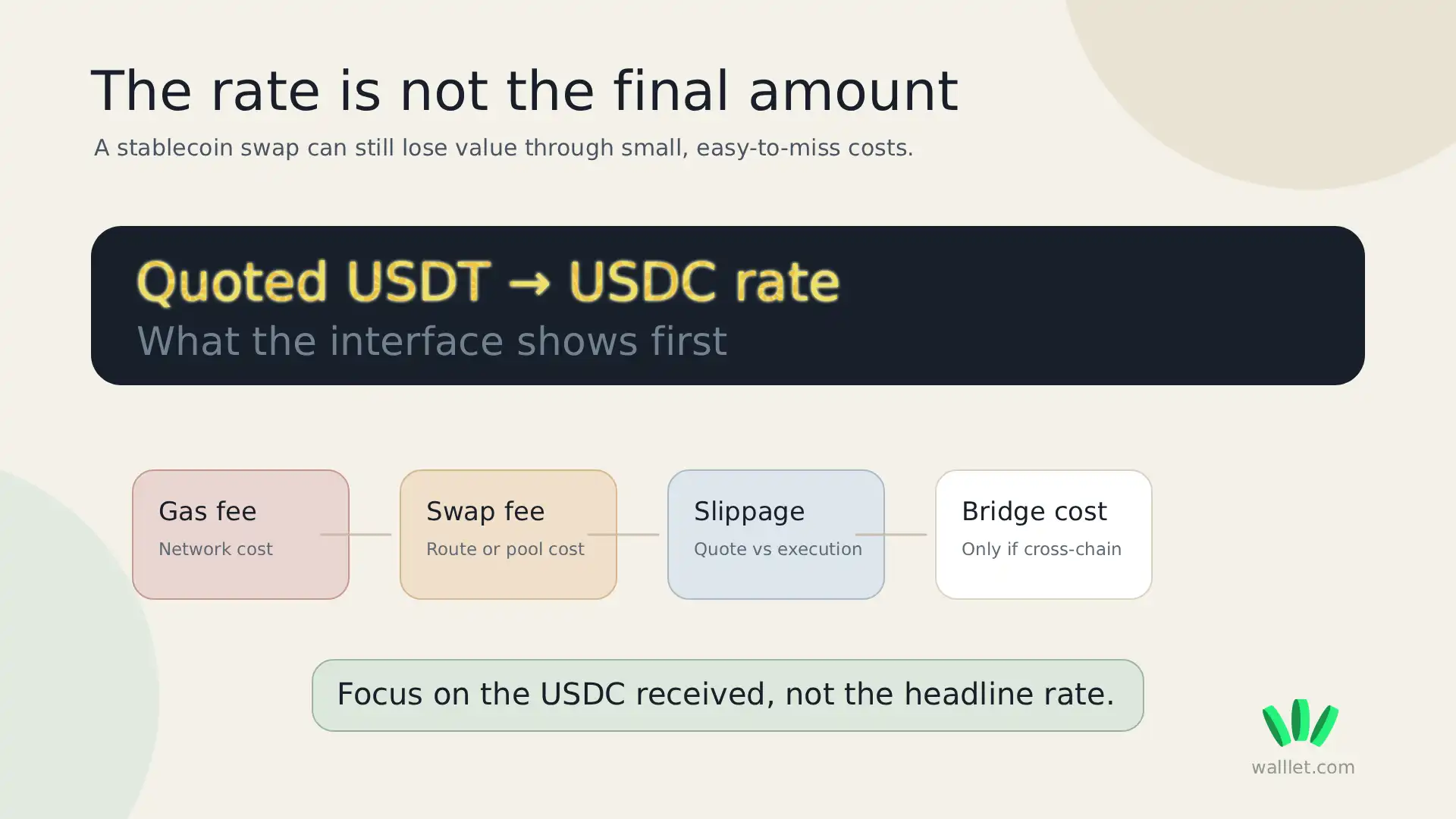
Gas is the network fee needed to process a blockchain transaction. Gas fees are transaction fees paid to get a transaction validated or completed, and defines slippage as the expected difference between a quoted and executed price. So if you swap 100 USDT and receive 99.60 USDC, the difference may come from one or more of these costs:
The network charged gas.
The swap route charged a fee.
The quote changed before execution.
The liquidity was not deep enough.
The route crossed networks.
The wallet, exchange, or aggregator added a service fee.
For a small swap, even a small fixed fee can matter. For a larger swap, slippage and route quality matter more. The rule is boring but useful: look at what lands in your wallet, not what the headline rate promises.
Should you use the same network or bridge first?
Use the same network when you can. A same-network swap is usually simpler than a cross-chain route. A same-network swap means your USDT and USDC are on the same blockchain. For example, USDT on Arbitrum to USDC on Arbitrum. A cross-chain swap means the route moves value between networks. That may involve a bridge, more fees, more waiting, and more things to approve. Before swapping, ask:
Where is my USDT now? Where do I need USDC? Can I swap directly on the same network? Does the destination accept USDC on this exact network?
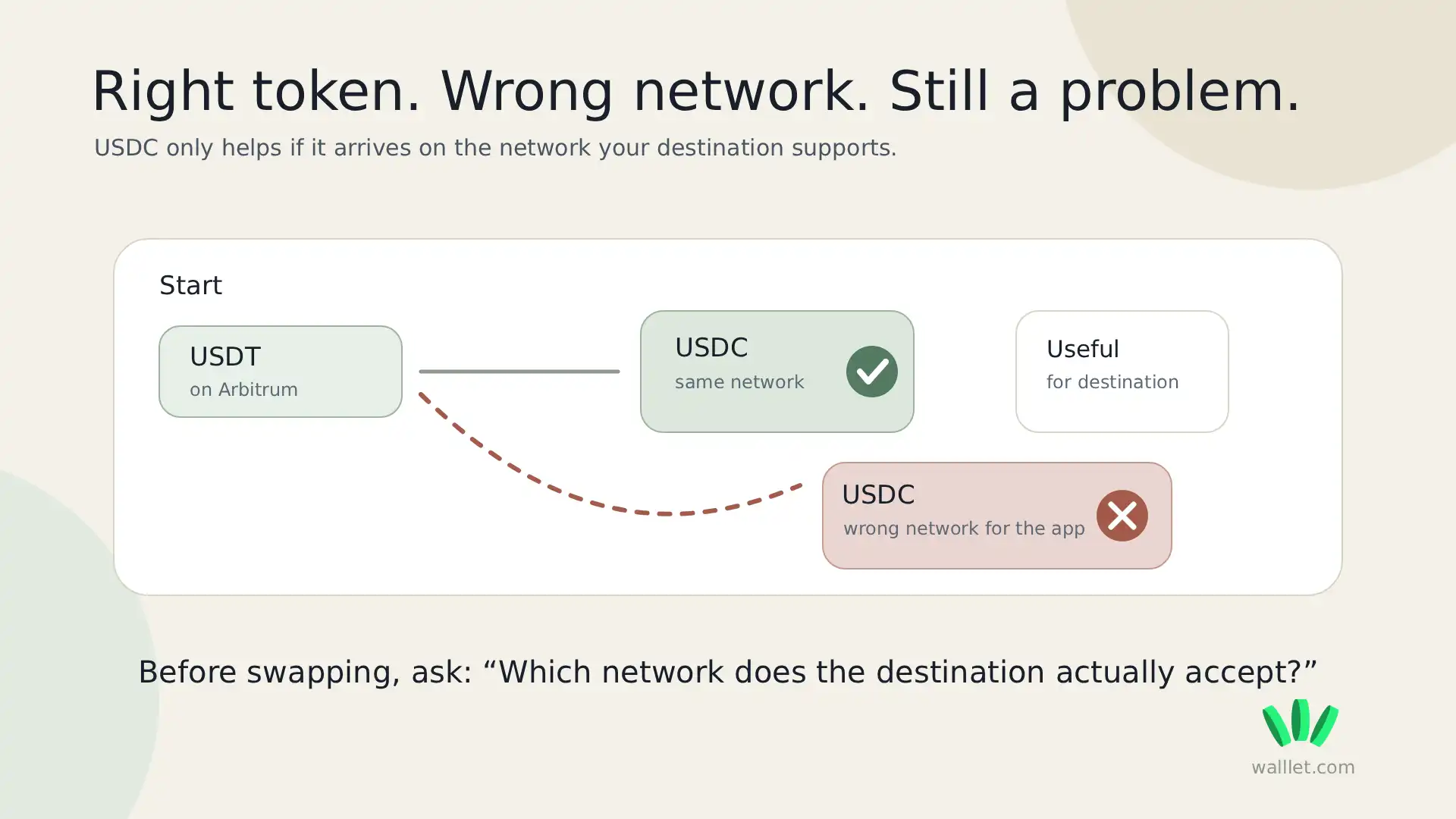
This is where many users get trapped. They swap into the “right” token, but on the wrong network. Technically successful. Practically useless. Crypto, being charming as ever.
Is USDC safer than USDT?
USDC is not automatically safe, and USDT is not automatically unsafe. They are different stablecoins with different issuers, reserve models, reporting practices, liquidity profiles, and market usage.
USDC may be preferred in some apps, payment flows, or regulated contexts. USDT may be more widely used in other markets, exchanges, and peer-to-peer flows. The better question is:
Which stablecoin is supported for what I need to do next?
If your next app needs USDC, swap may make sense. If your destination accepts USDT on the same network, keeping USDT may be cheaper and simpler.
When should you avoid swapping USDT to USDC?
Avoid the swap when the cost, risk, or confusion is bigger than the benefit. That usually means:
The destination already accepts USDT.
The gas fee is too high for the amount.
You don’t know which network you need.
The route includes a bridge you don’t understand.
The approval screen is unclear.
You’re swapping because of vague fear, not a specific need. Stablecoins are supposed to reduce volatility. They should not create a new way to lose money through avoidable confusion.
How can a wallet make a USDT to USDC swap less confusing?
A wallet can make a USDT to USDC swap less confusing by showing the user what they are approving, what token they are using, what network they are on, and what they should expect to receive.
That matters because many swap mistakes happen right before approval. A seedless self-custodial wallet like walllet.com is designed for users who want control of their crypto without managing a traditional seed phrase. For stablecoin users, the useful part is not just easier access. It is a clearer experience around actions like holding, moving, approving, and preparing to use USDT or USDC in real life.
For example, a freelancer may receive USDT from a client, then need USDC for a spending or payment flow. That person does not need a lecture about liquidity pools. They need to know: Is this the right token, on the right network, for the right amount?
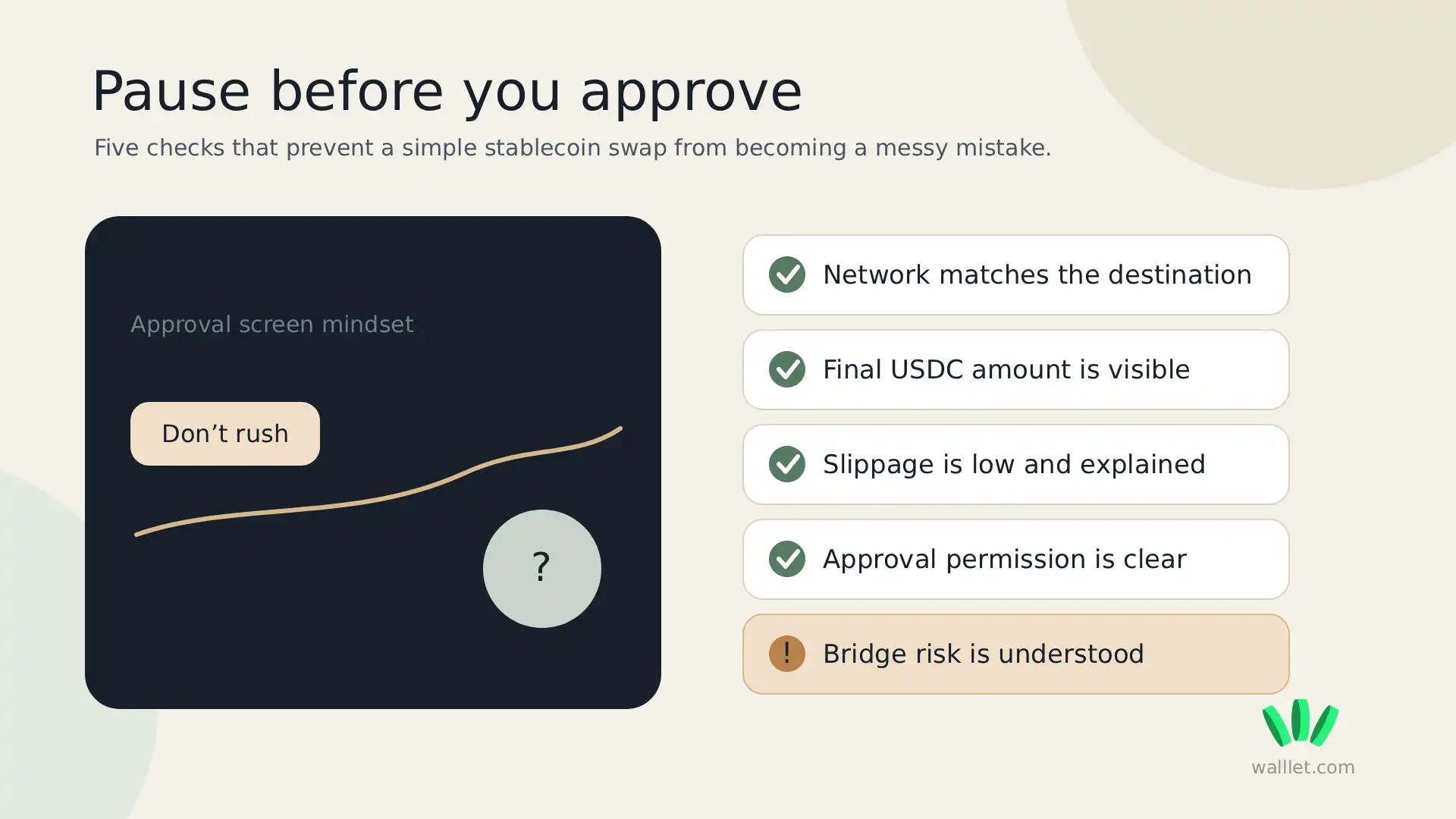
That is the kind of moment where clearer prompts, safer approvals, and less seed phrase anxiety actually matter.
Final checklist before you swap
Before you approve a USDT to USDC swap, check these:
Do I actually need USDC?
Is my USDT on the right network?
Will I receive USDC on the network I need?
What is the final amount after fees?
Is slippage clearly shown?
Does the route use a bridge?
Do I understand the approval?
Would keeping USDT be cheaper?
If the answer is unclear, pause. A delayed swap is usually better than a clean-looking mistake. Download walllet.com to manage stablecoins with simpler access, self-custody, and clearer transaction understanding before you approve crypto actions.
